
Dynamic Wireless Charging on Highways: Pilot Projects in the U.S. and Europe (Explainer Article)
Dynamic wireless charging (DWC)—also called in-road or dynamic inductive charging—promises to change how electric vehicles (EVs) refuel: instead of stopping to plug in, vehicles can receive power while moving over embedded coils beneath the road surface. For highways in particular, the technology is positioned as a potential solution to two persistent EV challenges: range anxiety and charging downtime. Yet DWC is not a single “plug-and-play” innovation; it is a system-level upgrade that involves civil engineering, grid integration, payment systems, interoperability standards, and fleet participation.
This article provides an SEO-friendly, explanatory overview of dynamic wireless charging on highways, focusing on pilot projects and test corridors across the United States and Europe, what they are trying to prove, and what still stands between pilots and scaled deployment.
How dynamic wireless charging works (in plain terms)
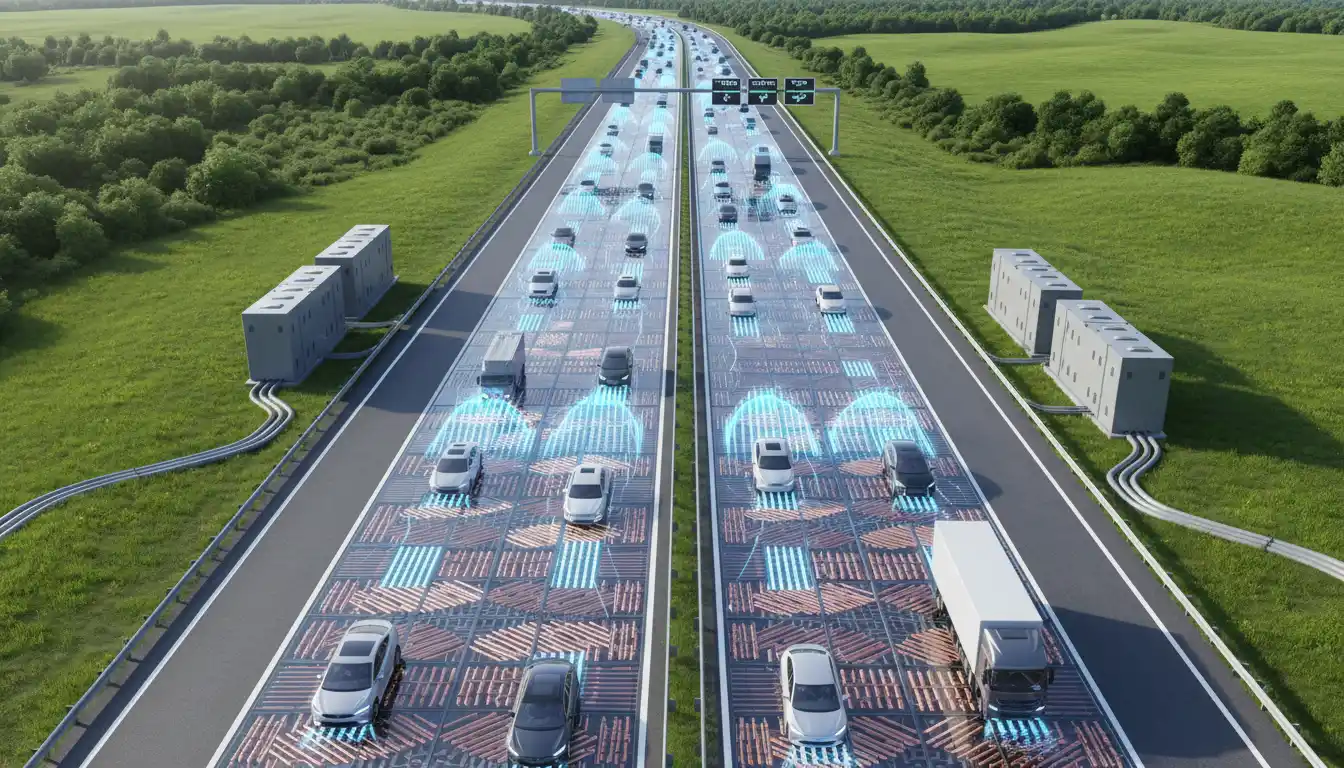
Dynamic wireless charging uses electromagnetic induction. Transmitter coils are installed under the pavement in specific segments (not necessarily the entire highway). An EV equipped with a compatible receiver pad aligns over the segment, and energy is transferred across an air gap through an alternating magnetic field. The vehicle then routes this energy to the battery and/or directly to the drivetrain.


Most pilot corridors emphasize “segmented” installations: short stretches that activate only when a compatible vehicle is detected. This design reduces energy waste, limits electromagnetic exposure, and helps operators manage costs. The road segments typically connect to roadside power electronics, which convert grid electricity into the appropriate frequency and control output based on vehicle demand.
The key idea is not that every car charges everywhere. Instead, DWC aims to support high-utilization routes and vehicles—freight trucks, buses, shuttles, and municipal fleets—where predictable travel patterns can justify the infrastructure investment.
Why highways are the primary target
Highway corridors concentrate energy demand and vehicle miles traveled. If DWC can reliably deliver power at speed, it could:
- Reduce the required battery size for some use cases (especially commercial fleets).
- Increase vehicle uptime by minimizing stationary charging.
- Smooth charging demand by shifting some energy delivery from depots and fast-chargers to the road itself.
- Potentially lower the number of ultra-fast DC stations needed on certain corridors.
However, highways also create the hardest environment: heavy axle loads, weather extremes, maintenance schedules, and the need to avoid lane closures. That’s why most projects begin with limited pilot segments, monitored closely for durability, efficiency, and operational safety.
Pilot projects in the United States: what’s happening and why it matters
Across the U.S., dynamic wireless charging has largely advanced through state DOT pilots, university-led demonstrations, and public-private partnerships. The American approach tends to be pragmatic: test the technology in real traffic, measure performance over time, and develop procurement and standards pathways for potential expansion.
1) State DOT-led roadway pilots
Several U.S. states have explored or launched pilot segments—often with the explicit goal of electrifying freight routes. These projects typically prioritize:
- Truck electrification: Heavy-duty trucks require large batteries; DWC could help reduce battery mass and charging stops.
- Winter and durability testing: Pavement performance, coil protection, and maintenance access matter as much as charging efficiency.
- Interoperability and vendor competition: DOTs want to avoid being locked into a single proprietary solution.
In most cases, U.S. pilots are designed around measurable milestones: energy transfer efficiency at highway speeds, system uptime, pavement lifecycle impact, and the total cost of ownership compared to alternatives like depot charging or overhead catenary systems.
2) University and test-track demonstrations
U.S. research institutions and mobility labs often serve as early validation environments. They help answer questions that DOTs and utilities care about:
- How consistent is charging when vehicles drift within a lane?
- What happens at different speeds and vehicle heights?
- How does rain, snow, salt, and thermal cycling affect performance?
- Can the system communicate securely with vehicles for billing and activation?
While these test beds don’t always reflect full highway complexity, they produce the data needed for permitting, safety guidelines, and infrastructure specifications.
3) Utility involvement and grid readiness
A critical U.S. theme is grid planning. Even short DWC segments can draw substantial power, and scaling across corridors requires:
- Distribution upgrades near highways
- Smart control to avoid peak overload
- Clear roles for utilities vs. road operators
- Cybersecurity and monitoring
U.S. projects increasingly treat DWC as “grid-connected transportation infrastructure,” not merely a roadway add-on. That mindset is essential for any real deployment.
Pilot projects in Europe: corridor thinking and standardization push
Europe has hosted some of the world’s most visible on-road wireless charging demonstrations, often tied to broader decarbonization policy, cross-border logistics, and standardization efforts. The European model frequently emphasizes coordinated planning: aligning governments, cities, automakers, suppliers, and standards bodies.
1) Electrified road corridor pilots
European pilots often test multiple electrification options—dynamic wireless charging, conductive rails, and overhead systems—because freight decarbonization is a strategic priority. These pilots aim to determine which approach best fits specific corridors, considering:
- Vehicle mix (passenger vs. freight)
- Road ownership and maintenance practices
- Winter conditions (e.g., snow management)
- Installation complexity and lifecycle cost
Dynamic wireless charging is typically evaluated for its “invisible” infrastructure advantage—no overhead poles—and for compatibility with mixed traffic if standards mature.
2) City-to-highway continuity (buses, shuttles, and logistics)
Europe has extensive experience with static wireless charging (charging pads at taxi ranks or bus stops). Dynamic highway pilots build on that foundation by asking: can wireless charging support a vehicle from depot, to city route, to highway segment, and back—without operational disruption?
This continuity is especially attractive for public transit agencies and logistics operators that want predictable energy delivery and minimal driver behavior change.
3) Stronger emphasis on interoperability standards
A major European advantage is the push for harmonized standards. If dynamic charging is to scale, EVs must be able to use infrastructure across regions and vendors. Standards also affect:
- Safety and electromagnetic field limits
- Communication protocols (vehicle-to-infrastructure)
- Billing and authentication
- Performance requirements and testing methods
Europe’s standardization culture can reduce fragmentation—an essential step if DWC is to become more than a collection of isolated pilots.
What pilots are trying to prove (the real checklist)
Whether in the U.S. or Europe, pilots are less about flashy demos and more about answering hard questions:
- Efficiency at speed
How much energy actually reaches the battery under real-world conditions? - Alignment tolerance
Can the system perform when vehicles are not perfectly centered in a lane? - Durability and maintenance
Do embedded coils survive heavy vehicles, freeze-thaw cycles, resurfacing, and road repairs? - Safety and electromagnetic exposure
Are emissions within regulatory limits, and is shielding effective? - Interoperability
Can multiple vehicle brands and infrastructure vendors work together without custom engineering every time? - Economics
Does the total cost (installation + energy + maintenance) compete with alternatives? - Grid impact
Can local networks support it, and can power be managed intelligently? - User experience and billing
Does charging start automatically, does it “just work,” and is billing seamless?
The strongest pilots publish performance metrics and build procurement playbooks so future projects can replicate success without starting from scratch.
Benefits and trade-offs: a realistic view
Dynamic wireless charging has compelling advantages, especially for fleets. But it also faces real constraints.
Potential benefits
- Reduced downtime: Energy delivered while driving.
- Smaller batteries for some use cases: Potential cost and weight savings.
- Better fleet utilization: Particularly for freight and transit.
- Less reliance on ultra-fast charging hubs: Could reduce congestion at charging stations.
Key challenges
- High upfront infrastructure cost: Civil works and power electronics are expensive.
- Vehicle hardware requirement: Receiver pads add cost and must be standardized.
- Maintenance complexity: Roads are regularly resurfaced; embedded systems must be serviceable.
- Fragmentation risk: Without standards, each pilot becomes a silo.
- Uncertain business model: Who owns it—road operator, utility, private concessionaire?
For that reason, many experts view DWC as a targeted tool rather than a universal solution—best deployed where traffic volume, fleet adoption, and corridor importance justify the investment.
What comes next: from pilots to scaled deployment
For dynamic wireless charging to move beyond pilot status, the next phase will likely include:
- Longer continuous segments on freight-heavy routes to demonstrate meaningful range extension
- Multi-vendor interoperability trials to prove standard alignment
- Fleet-focused rollouts (trucks, buses) where ROI is clearest
- Integration with renewable energy and smart grids to manage peak demand
- Policy frameworks for procurement, safety certification, and public-private financing
In both the U.S. and Europe, the core story is the same: pilots are laying the groundwork for confidence—technical, financial, and regulatory. If the data proves reliability and economics, dynamic wireless charging could become a strategic layer in the EV charging ecosystem, particularly on highways where time and distance matter most.