
AI-Optimized 3D Printing: Smarter Prototyping for Inventors Everywhere
The fusion of Artificial Intelligence (AI) and 3D printing—often referred to as additive manufacturing—is sparking a new industrial revolution. For inventors, engineers, and hobbyists, this synergy is not just a technical upgrade; it is a fundamental shift in how ideas transition from digital concepts to physical realities. AI-optimized 3D printing is democratizing complex engineering, making high-precision prototyping accessible to everyone from garage inventors to multinational corporations.
The Evolution of Prototyping: From Manual to Autonomous
Traditionally, 3D printing required a steep learning curve. Users had to manually calibrate machines, experiment with various filament settings, and endure frequent print failures due to warping or poor adhesion. AI is changing this narrative by introducing “smart” layers into the manufacturing process. By utilizing machine learning algorithms, 3D printers can now predict potential errors before they occur, adjusting parameters in real-time to ensure a successful build.
This evolution is particularly vital for the prototyping phase. In the past, creating a prototype was a linear process: design, print, fail, and repeat. With AI integration, the process becomes iterative and self-correcting. Generative design, a subset of AI, allows inventors to input specific constraints—such as weight, strength, and material type—and the software generates thousands of optimized design variations that a human might never conceive.



Generative Design: Engineering Beyond Human Limits
One of the most powerful applications of AI in 3D printing is generative design. Instead of drawing a part manually, an inventor defines the problem. For instance, if you need a drone frame that is ultra-lightweight but can withstand high-velocity impacts, AI algorithms explore every possible geometric configuration.
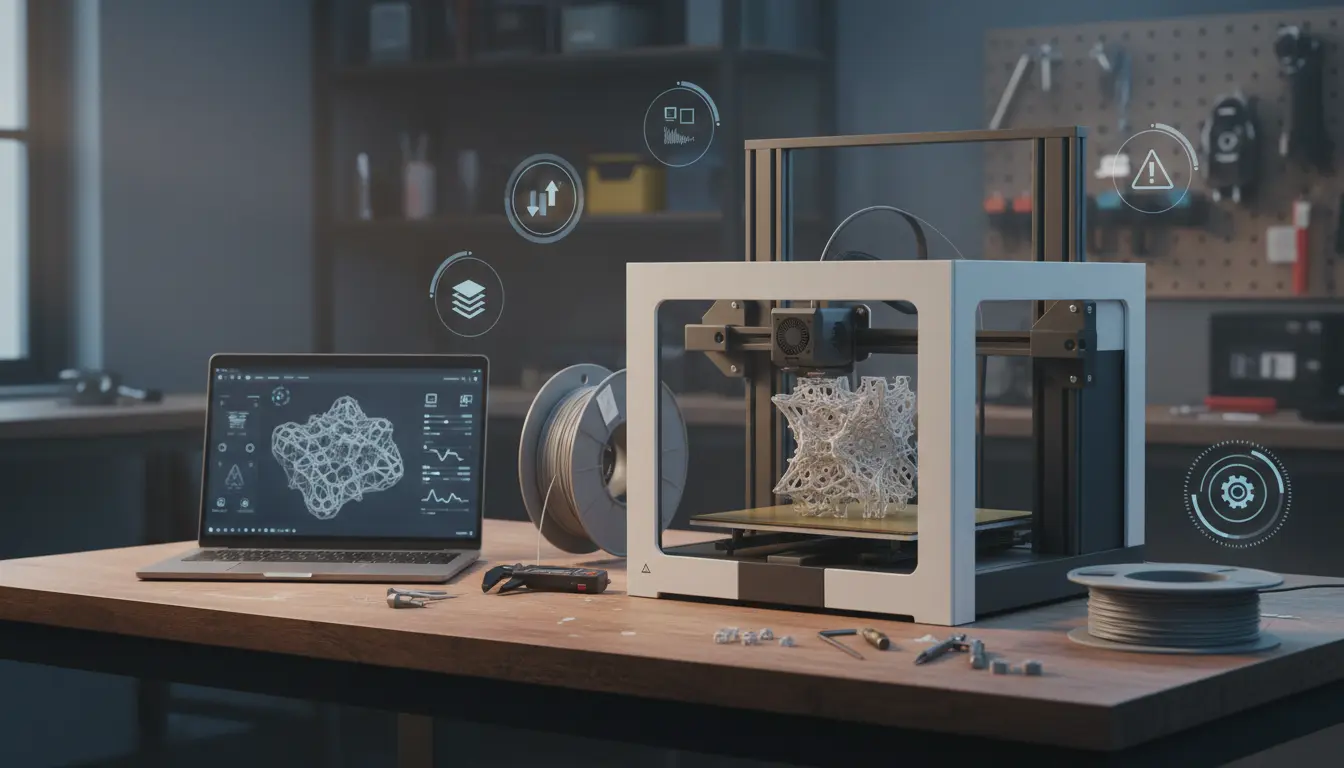
The result is often an organic, lattice-like structure that mimics biological forms. These shapes are incredibly efficient, using the minimum amount of material necessary to achieve maximum structural integrity. Because 3D printers can handle complex geometries that traditional milling or molding cannot, these AI-optimized designs are perfectly suited for additive manufacturing. This leads to significant material savings and reduced energy consumption, making the prototyping process both smarter and more sustainable.
Real-Time Monitoring and Predictive Maintenance
The “smart” in smarter prototyping also refers to the hardware’s ability to look after itself. AI-powered vision systems, equipped with high-resolution cameras and sensors, monitor the print bed during every second of the process. If the system detects a “spaghetti” failure or a slight shift in the layer alignment, it can automatically pause the print or attempt a correction.
For inventors, this means no more wasted filament or overnight failures that stall a project. Furthermore, predictive maintenance algorithms analyze the vibration and thermal data of the printer. They can alert the user when a nozzle is likely to clog or when a belt needs tightening. This proactive approach ensures that the tools of innovation are always ready for use, minimizing downtime and maximizing productivity.
Material Science and AI: Finding the Perfect Match
The success of a 3D-printed prototype often hinges on the material used. AI is currently being used to accelerate material science, discovering new polymer blends and metal alloys specifically designed for 3D printing. By simulating how different molecules interact under the heat and pressure of a 3D printer, AI can predict the mechanical properties of a new material without the need for costly physical testing.
This allows inventors to choose materials that are perfectly optimized for their specific application, whether it’s a biocompatible implant for medical use or a heat-resistant component for an aerospace engine. The ability to tailor material properties at the microscopic level is a game-changer for functional prototyping.
Democratizing Innovation: The Global Impact
Perhaps the most significant benefit of AI-optimized 3D printing is its role in democratizing innovation. In the past, high-end prototyping was the domain of well-funded R&D labs. Today, a smart 3D printer combined with AI-driven cloud software gives a solo inventor in a remote part of the world the same prototyping power as a major tech firm.
This “smarter prototyping” ecosystem lowers the barrier to entry. It reduces the cost of failure, encourages experimentation, and speeds up the time-to-market for new products. As AI continues to learn from millions of print jobs globally, the collective intelligence of the network grows, making the technology more reliable and efficient for everyone.
The Future: Fully Autonomous Manufacturing
Looking ahead, we are moving toward a future of fully autonomous manufacturing. Imagine a system where an inventor speaks a concept into an AI interface, the AI designs the part, selects the optimal material, and sends it to a 3D printer that self-calibrates and completes the job with zero human intervention.
AI-optimized 3D printing is not just about making things; it’s about making things better, faster, and more intelligently. It is the bridge between the digital imagination and the physical world, empowering inventors everywhere to turn their boldest ideas into reality.