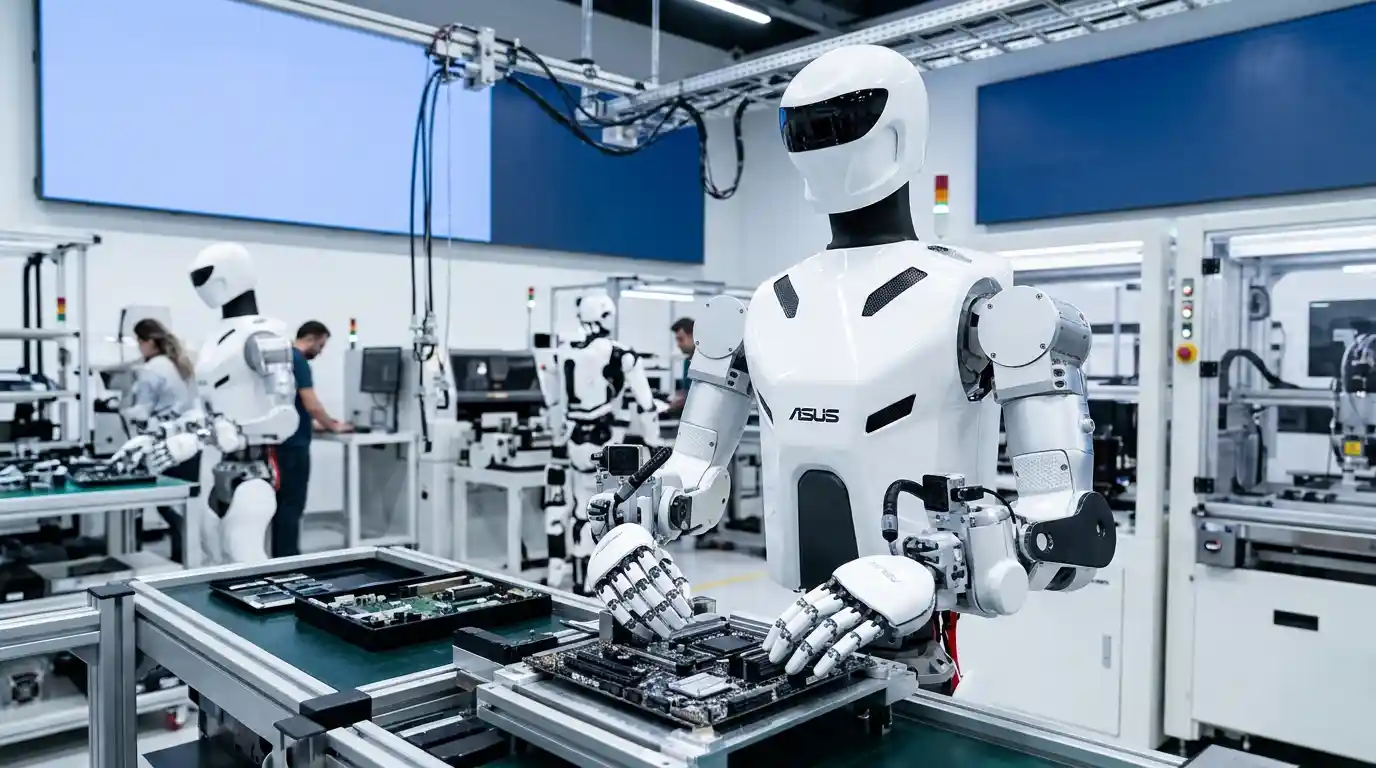

The ASUS Gallop humanoid robot tackles a practical question: can intelligent machines perform useful factory work consistently, rather than simply impress audiences? ASUS is developing Gallop around an actual electronics manufacturing workstation, where speed, accuracy, and repeatability matter more than theatrical movement. Its approach connects physical AI with everyday production demands. Instead of designing a demonstration first and searching for applications later, the company has selected a difficult packing task and built its development process around measurable operational requirements.
Why ASUS Chose a Humanoid Design
Factories already organize countless workstations around human reach, tools, and hand movements. Traditional automation handles stable, repetitive processes effectively, but changing products and delicate components can complicate deployment. ASUS sees an opportunity for a robot that uses existing stations rather than requiring manufacturers to redesign their surroundings.
Gallop currently operates from a fixed base with two arms. ASUS plans to introduce a wheeled version next. Its immediate value therefore lies in workstation manipulation, not humanlike walking. This distinction keeps expectations grounded: the project focuses on useful handling capabilities before expanding mobility.
A Packing Station Provides the First Test
Gallop begins at an ASUS group electronics manufacturing services factory, packing motherboard accessories. The workstation involves 15 small parts, including items inside thin, transparent bags. ASUS targets a 99.5% success rate within 20 seconds, matching the standard it applies to a person performing the task.
These figures describe development goals, not independently verified production results. That distinction matters when evaluating humanoid robot automation. A promising training cycle does not automatically establish reliable performance across an entire shift.
The task also exposes weaknesses that simpler gripping systems face. Flexible packaging changes shape, small components demand careful positioning, and transparent materials complicate visual interpretation. By choosing this station, ASUS tests whether Gallop can handle most of a complete job without constant human assistance.
How Gallop Learns From Experienced Workers
ASUS combines existing open AI models with knowledge gathered directly from its manufacturing environment. Rather than building a giant foundation model from scratch, the team starts with models that already understand relationships between hands and objects.
Experienced employees then demonstrate the packing process while wearing small head cameras with their consent. Their actions provide examples of how skilled people approach the actual workstation. Simulation introduces variations, helping the robot prepare for changes instead of memorizing one rigid sequence.
Operators also use virtual reality headsets and gloves to guide Gallop through physical practice. This stage uses the same parts and cameras as the production station. Once deployment begins, recorded operating experience feeds further training. Together, these methods support robot learning from demonstration while preserving a direct connection to workplace conditions.
A Modular Architecture Supports Continuous Improvement
Gallop divides its software into four cooperating layers. A planner interprets the scene and breaks the assignment into steps. A separate supervisory AI checks progress and adjusts the plan when execution encounters problems.
Below those reasoning functions, a skills layer manages actions such as reaching, grasping, and placing. A control layer directs precise arm and hand movements and stops operation when something goes wrong. Fixed interfaces connect these layers, allowing ASUS to replace individual models without rebuilding the entire machine.
This modular robotics architecture addresses a practical challenge: AI software evolves faster than industrial equipment. Separating capabilities could help ASUS incorporate better models while retaining the surrounding hardware and established interfaces. However, each upgrade still needs validation against the demands of the real task.
Hardware Built Around Dexterous Manipulation
A single NVIDIA Jetson AGX Thor computer inside Gallop runs its computing workload using standard robotics software. ASUS designs the robot body and develops its own dexterous hand with tactile sensing, while established partners supply motors and other standard components.
The company identifies the hand as a particularly difficult element. Touch feedback and adaptable manipulation matter when objects bend, slip, or sit unpredictably inside packaging. ASUS plans to integrate its own hand into Gallop during the next development stage, so readers should distinguish that roadmap from capabilities already demonstrated publicly.
Timeline, Human Roles, and Realistic Expectations
ASUS started the Gallop program in early 2026. It plans customer pilots during 2027, a customer showcase at Computex 2027, and market availability in the second half of 2028. These remain company plans and targets rather than guaranteed delivery dates.
Electronics manufacturing comes first. ASUS also sees longer term possibilities in hospitals and service environments because different workplaces share basic picking and placing requirements. Those applications represent future ambitions, not established deployments.
ASUS positions Gallop around repetitive, physically demanding stations that employers struggle to staff. It expects experienced workers to help configure, supervise, and improve robots. The strongest test will therefore involve more than technical accuracy: manufacturers will need to assess dependable operation, manageable oversight, and meaningful usefulness within existing production workflows.
Buyers should examine how Gallop recovers from mistakes, adapts to changing materials, and maintains consistent quality when ordinary production conditions become less predictable.
Gallop makes physical AI tangible by treating the factory as its proving ground. Its credibility will ultimately depend on repeated workplace results, not impressive demonstrations alone.
Source: Factory-Proven Physical AI: Why ASUS Is Building a Humanoid Robot,