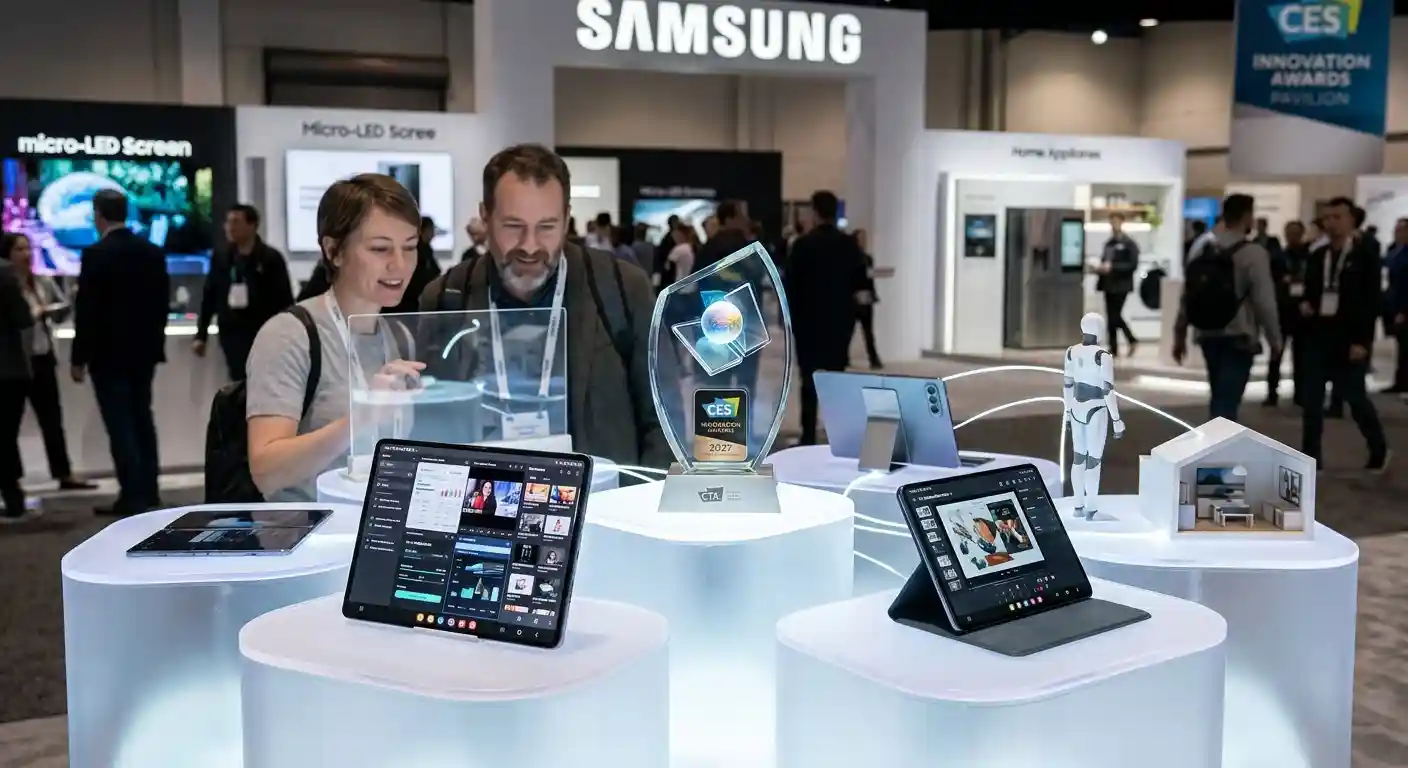

Samsung’s latest technology story reaches beyond brighter screens and slimmer phones. The Samsung CES 2027 Innovation Awards announcement connects foldable design, household convenience, and advanced computing through one practical question: how can better engineering make technology easier to use?
In its November 15, 2026 announcement, Samsung says the Consumer Technology Association recognized products across mobile devices, entertainment, home appliances, and semiconductors. The company also reports twice as many Best of Innovation winners as in 2026. These honors offer a preview of its priorities before CES opens in Las Vegas on January 6, 2027.
Foldable Smartphones Follow Two Different Paths
Samsung earned Best of Innovation recognition for both the Galaxy Z Fold8 Ultra and Galaxy Z Fold8. Rather than treating foldable smartphones as one uniform category, the company gives each model a distinct purpose.
The Fold8 Ultra emphasizes productivity. Its main display measures eight inches, while its unfolded body measures 4.1 millimeters thick. Samsung lists a weight of 215 grams and a 5,000mAh battery. Together, these specifications target people who want a larger workspace without carrying a conventional tablet everywhere.
Photography also plays a central role. A 200MP wide camera supports HDR at full resolution, while a 50MP ultrawide camera adds macro photography. Samsung says the ultrawide camera captures approximately 34% more light than its predecessor through a wider aperture.
The standard Fold8 takes another route. A compact 5.5-inch cover display handles quick interactions, while the unfolded 7.6-inch screen uses a 4:3 aspect ratio for entertainment and discovery. Dual 50MP cameras and simultaneous front and rear recording extend its creative possibilities.
Display Engineering Supports Everyday Usability
Both devices introduce Flex Titanium display structures, although Samsung describes different constructions for each model. The underlying goal remains consistent: reduce display thickness, support durability, and make the crease less noticeable.
For buyers, these changes matter because folding hardware must balance portability with confidence during repeated use. However, award recognition does not replace independent durability testing. Consumers should compare practical reviews, repair options, and warranty terms before choosing an expensive device.
Smart Home Innovation Moves Beyond Novelty
Samsung’s announcement also highlights smart home innovation through its appliance division. The enhanced Bespoke AI Laundry Combo earned an Innovation Awards Honoree designation, continuing recognition that the original model received in 2024.
The broader message favors convenience, efficiency, and useful functionality over isolated features. A connected home becomes more appealing when appliances simplify familiar routines rather than demand constant attention.
Samsung also reports recognition for display and audio technologies, including two Best of Innovation winners from its Visual Display business. The announcement does not identify those products, so readers should avoid assuming particular television models received awards.
AI Server Memory Addresses Growing Computing Demands
Behind the consumer devices, AI server memory forms another important part of Samsung’s awards story. Its 512GB DDR5 RDIMM uses 32Gb DRAM and a four-layer stacking structure to increase capacity while simplifying packaging.
Samsung says these modules can deliver 8TB across a server configuration with 16 memory channels and one DIMM per channel. It also claims up to 15% lower power consumption than conventional 16Gb-based 512GB modules.
Meanwhile, LPDDR5X SOCAMM2 targets AI servers with bandwidth reaching 153.6GB per second. Its detachable design allows memory replacement without replacing the motherboard. That serviceability could help operators adapt systems as workloads grow.
On-Device AI Storage Gains Importance
Samsung’s UFS 5.0 recognition highlights the growing role of on-device AI storage. The company specifies bandwidth up to 10.8GB per second and twice the sequential reading and writing performance of UFS 4.1.
Faster storage can help devices load AI models and move large files more efficiently. Samsung also claims 40% better power efficiency, although actual battery benefits will depend on the device and workload.
What Buyers Should Watch Next
Samsung plans to publish its complete award-winning product list on January 4, 2027, before CES runs from January 6 through January 9. Until then, the announcement provides direction rather than a complete purchasing guide.
The strongest takeaway concerns balance: larger screens need manageable bodies, smarter appliances need useful routines, and stronger AI needs efficient components. Buyers should judge those promises against independent testing and their own needs. The distinction matters most when impressive specifications translate into less friction during ordinary work and leisure.
Source: Samsung’s Latest Products Recognized by Consumer Technology Association Ahead of CES 2027