
Healthcare professionals rarely lack information. Instead, they struggle to find the right detail inside years of scattered documentation. A crucial observation might sit in an old discharge summary, while a recent test result appears elsewhere. AI for care teams addresses this practical problem by helping clinicians connect evidence, prioritize reviews, and spend more time caring for patients.
NVIDIA describes how Dyania Health approaches this challenge through Synapsis AI, a clinical reasoning engine that examines patient records while keeping clinicians responsible for decisions.
Why Medical Records Need More Than Search
Patient histories contain more than structured fields and laboratory values. Physicians record symptoms, treatment responses, imaging interpretations, and surgical findings in narrative documents. Understanding those details often requires context that a simple keyword search cannot provide.
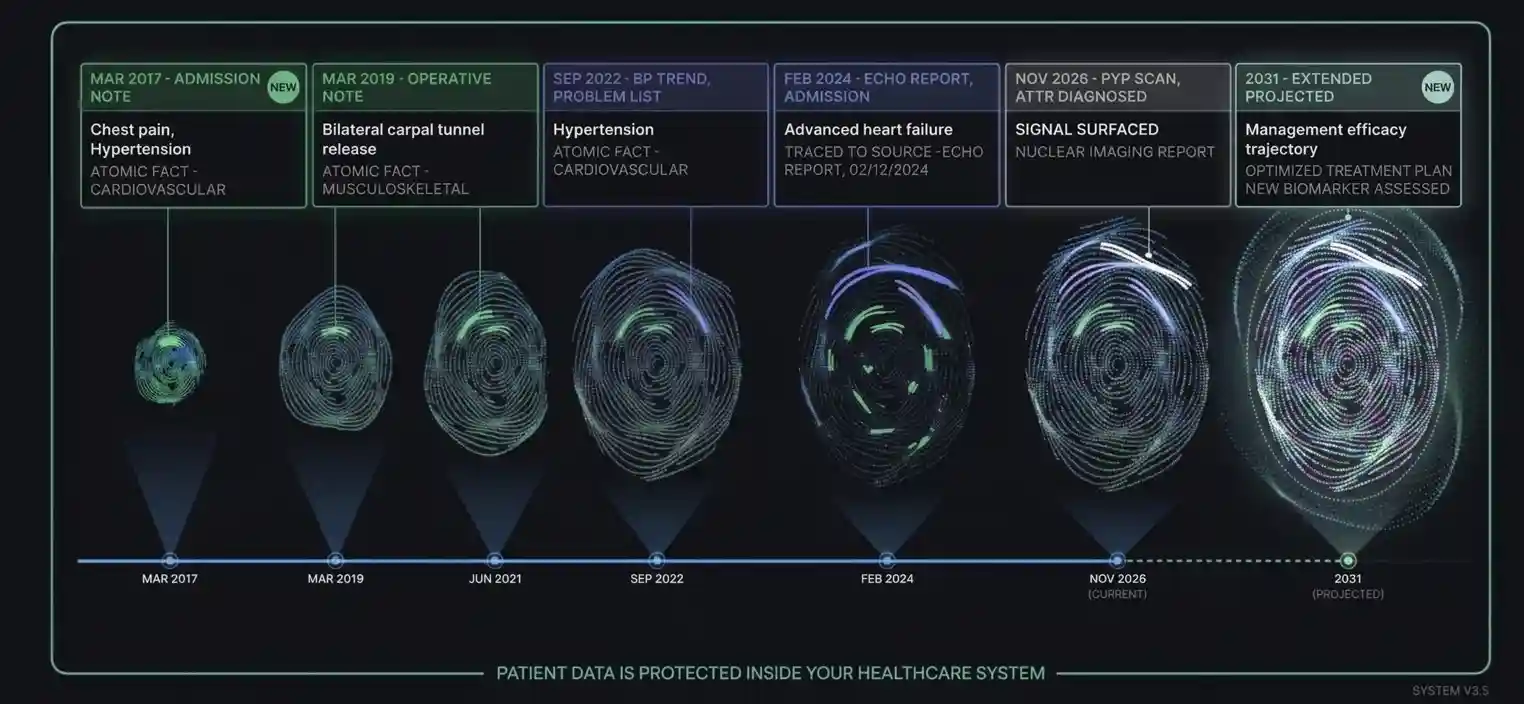
Synapsis AI works across notes, reports, and laboratory results to connect findings that may span several years. According to NVIDIA, the system produces clinical signals that link back to supporting information in the original record.
That traceability matters. Rather than accepting an unexplained recommendation, a clinician can examine the evidence, judge its relevance, and decide whether a patient needs further attention. Clinical decision support becomes more useful when professionals can understand what prompted a finding.
Keeping Clinical Judgment at the Center
The strongest argument for AI for care teams is not that software should replace expertise. It is that clinicians should not have to spend valuable appointment time reconstructing information that already exists.
Dyania positions Synapsis AI as an assistive tool. The platform identifies potentially relevant evidence, but clinicians must verify the findings and determine the next step. This division of responsibility preserves the difference between discovering information and making a medical decision.
Healthcare workflow automation can therefore support preparation and review without turning treatment into an automatic process. A useful implementation gives professionals clearer evidence, not another system that demands unquestioning trust.
Processing Sensitive Data Inside the Hospital
Privacy also shapes whether hospitals can use advanced analytics confidently. NVIDIA reports that Synapsis AI runs on accelerated computing within a health system’s own firewall, processing patient records onsite rather than sending them outside the hospital.
This deployment model addresses an important operational concern: where sensitive information travels during analysis. However, local processing should not replace broader governance. Hospitals still need appropriate access controls, oversight, and procedures for reviewing how staff use the results.
Dyania develops and trains its clinical models with NVIDIA NeMo libraries. It then uses NVIDIA TensorRT and TensorRT-LLM to improve inference efficiency on hospital GPU servers. For care teams, the practical aim is faster access to relevant information within their existing institutional environment.
What Heart Valve Research Reveals
A Cleveland Clinic study provides a concrete example of AI assisted medical record review. According to NVIDIA, researchers used Synapsis AI to support analysis of more than 7,800 patients who underwent aortic valve replacement between 2005 and 2021.
The platform examined longitudinal records, including echocardiograms collected after surgery. Researchers used this information to develop a predictive model for valve deterioration and reintervention risk at three, five, and ten years following the procedure.
NVIDIA states that reviewing the full cohort manually would have taken clinicians years. The example illustrates how automated evidence gathering can make an extensive research task more manageable. It does not, by itself, establish that every hospital will achieve the same results or that predictions can replace individual assessment.
Where Care Teams Could Apply This Approach
The same underlying capability could help hospitals identify candidates for clinical trials, investigate gaps in cardiology or oncology care, and populate clinical registries. Each application depends on finding relevant evidence across complex histories rather than examining a single isolated result.
Clinical trial matching particularly benefits from careful attention to eligibility details. AI can help surface possible candidates, while research teams confirm whether the complete criteria apply. Similarly, patient data privacy remains essential whenever organizations expand access to information or introduce additional analytical tools.
For hospitals considering adoption, the key question is whether the tool helps staff review evidence more effectively. Teams should examine the quality of source links, clarify who checks each finding, and ensure that useful signals lead to appropriate follow through rather than additional noise.
The real opportunity lies in making existing records more actionable. When hospitals combine traceable outputs, appropriate infrastructure, and clinical oversight, AI for care teams can support a more focused review process. The goal is straightforward: help professionals recognize important information sooner while keeping responsibility for patient care firmly in human hands.
Source: NVIDIA Blog — How AI Is Helping Care Teams Get Patients the Right Care, Sooner