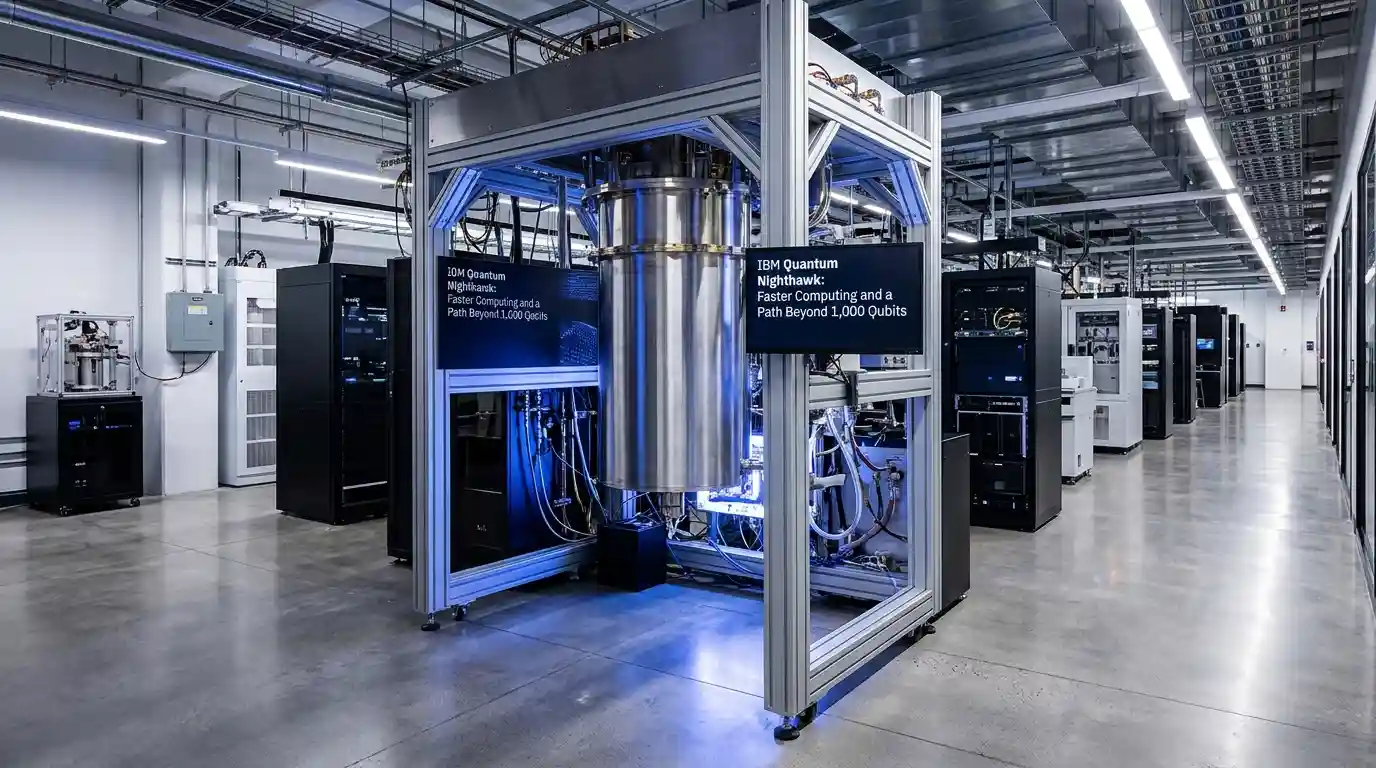

Quantum computing needs more than impressive qubit counts. Researchers also need reliable operations, rapid execution, and practical connections to classical systems. IBM Quantum Nighthawk addresses these priorities through faster existing hardware and a larger processor planned for 2027. Announced on November 11, 2026, IBM’s latest roadmap combines measured performance gains with ambitious scaling targets. The distinction matters: Nighthawk r2 already runs customer workloads, while Nighthawk r3 represents the next planned step toward larger quantum computations.
Why Speed Changes the Quantum Computing Equation
A quantum computer typically generates samples rather than producing a complete answer through one execution. Researchers repeat circuits many times, then analyze the resulting measurements. Complex workloads can require millions or billions of samples, making execution speed essential to practical research.
IBM says Nighthawk r2 delivers up to 100,000 samples per second and supports accurate computations involving more than 7,500 quantum operations on 120 qubits. Its fast qubit reset technology shortens the interval between circuit executions. That improvement helps researchers gather data faster without treating computational quality as an afterthought.
These capabilities highlight a broader lesson: useful quantum performance depends on how much meaningful work a system completes, not simply how many qubits it contains.
What Nighthawk r2 Has Already Demonstrated
According to IBM, clients and partners have executed 34 billion circuits on Nighthawk r2, reporting improvements of up to 19 times over earlier IBM quantum processors. These figures describe particular workloads, not a universal acceleration across every quantum application.
E.ON reported a fifteenfold speedup for quantum machine learning research involving energy grid optimization. IBM also reported a twelvefold acceleration when repeating a magnetic materials simulation previously conducted with Oak Ridge National Laboratory. Both comparisons used earlier work on IBM Quantum Heron as their reference.
An Algorithmiq materials experiment ran eight times faster on Nighthawk r2 than its original Heron implementation. IBM estimates that matching the newer circuits’ accuracy with leading classical tensor network methods would require 240 times more memory. That estimate concerns simulation difficulty; it does not establish that quantum computers outperform classical machines on every task.
How Nighthawk r3 Plans to Scale
IBM designed Nighthawk r3 to support 10,000 quantum operations across 520 programmable qubits. The processor includes 2,034 physical qubits in total, so readers should distinguish its programmable capacity from its overall physical count.
The design retains square lattice connectivity and introduces ten interconnects called l-couplers. These links support modular quantum computing by connecting separate processors rather than relying exclusively on a single larger chip.
IBM plans to connect two r3 processors into a 1,040-qubit system in 2027. Supporting demonstrations include quantum state transfer between earlier Nighthawk processors with 99.3 percent fidelity. IBM identifies 99.9 percent as its target, not an achieved result.
The company also connected two cryogenic modules, cooled them below 15 millikelvin, and reached operating temperature in under five days. These engineering milestones support its scaling strategy, although they do not guarantee that every roadmap objective will arrive on schedule.
Why Classical Computing Remains Essential
Larger quantum workloads create additional work for conventional computers. Researchers use classical resources to manage workflows, characterize noise, process measurements, and support quantum error correction. IBM Quantum Platform brings these resources together in a managed environment that connects quantum execution with high-performance computing.
IBM and RIKEN reported that their sample-based quantum diagonalization workflow ran roughly five times faster while performing 100 times more computations than the original study. Separately, Cleveland Clinic and RIKEN used automated workflows to process 608 million samples for biologically relevant structures, achieving a reported thirty-threefold acceleration compared with execution without workflow automation.
These results illustrate hybrid quantum-classical computing in practice: quantum processors generate specialized measurements, while classical infrastructure helps turn those measurements into usable research outputs.
What the Announcement Really Means
IBM Quantum Nighthawk strengthens the case for evaluating quantum systems through speed, quality, connectivity, and workflow efficiency together. Faster sampling can expand experimental capacity today, while modular hardware could enable larger computations tomorrow.
However, scaling physical hardware does not automatically deliver fault-tolerant quantum computing. Researchers still need better error handling and dependable operation across increasingly complex systems. IBM’s pulse-level controls and expanded classical integration aim to support that work.
For businesses and research teams, the announcement offers concrete performance reports alongside clearly stated future targets. The most useful takeaway is not that quantum computing has solved every practical challenge, but that IBM is tackling several interconnected barriers through a coordinated hardware and software roadmap.
This approach gives organizations a clearer framework for assessing progress without confusing experimental milestones with broadly available commercial advantage.
Source: IBM Newsroom — November 11, 2026