
A Faster Route for Long-Distance Data
An internet connection can move enormous files yet still feel sluggish when applications wait for distant servers. That distinction explains why China’s latest hollow-core fiber demonstration deserves attention. Researchers reportedly transmitted 64 terabits per second in each direction across 1,007 kilometers, or approximately 626 miles, while reducing latency compared with conventional fiber.
According to TechRadar’s report, the project involved China Telecom Research Institute, Yangtze Optical Fibre and Cable, and ZTE. The achievement points toward faster infrastructure rather than an immediate upgrade for household broadband customers.
How Hollow-Core Fiber Changes the Journey
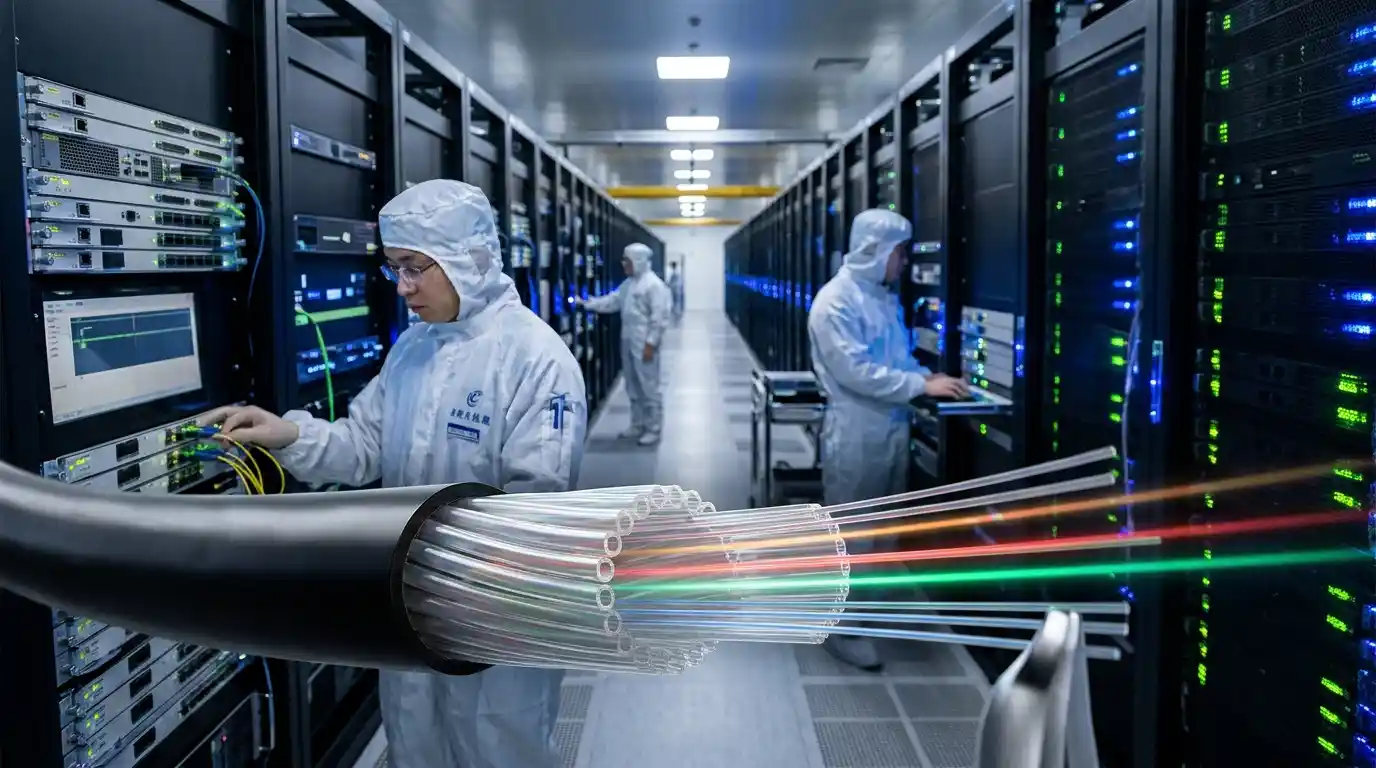
Conventional optical fiber guides light through a solid glass core. Hollow-core fiber instead guides most of that light through an air-filled channel surrounded by carefully engineered glass structures. Those structures keep the optical signal confined as it travels along the cable.
The important difference concerns propagation: light travels faster through air than through glass. Engineers can therefore reduce the time signals spend crossing a physical route without shortening the route itself. This approach gives fiber optic technology another way to improve network performance beyond simply carrying more traffic.
Understanding the 64 Tbps Headline
The reported capacity describes the combined data that the experimental link carried in one direction. Because the demonstration supported traffic both ways, researchers achieved that capacity separately in each direction. Readers should not confuse this infrastructure measurement with the speed of a single home connection.
TechRadar illustrates the scale by comparing the capacity with transferring around 160 movies every second, assuming each 4K movie occupies 50 gigabytes. That comparison communicates volume, not a promise about streaming services. Actual downloads also depend on server limits, network congestion, equipment, and the customer’s subscription.
Why Lower Latency Matters
Bandwidth measures how much information a connection can carry. Latency measures how long information takes to reach its destination. Increasing one does not automatically improve the other, which explains why impressive download speeds cannot eliminate every delay.
The report states that signals crossed the experimental link in 3.43 milliseconds and that the team reduced latency by 30 percent. These figures describe the demonstrated transmission link, not every component of an internet session. Routers, access networks, and application processing still add delays.
Even so, low latency networks could help services that require frequent exchanges between distant systems. Cloud applications, interactive collaboration, and connections between computing facilities could benefit when operators reduce transmission delays along important routes.
Where the Technology Could Arrive First
Large infrastructure links offer a more realistic starting point than residential cable replacements. Operators can target routes where faster communication delivers clear operational value, especially connections involving data centers. Such deployments could improve the networks behind familiar services without changing the cable entering a customer’s home.
Data center connectivity also provides a useful context for evaluating the breakthrough. A faster physical link can support communication between facilities, but operators must consider the entire system. Switching equipment, traffic management, and application design all influence the experience that users ultimately notice.
What Still Stands Between Trials and Deployment
A successful demonstration does not automatically create an affordable nationwide network. TechRadar notes that hollow-core cables remain harder to manufacture and install than conventional alternatives. Engineers must preserve the delicate internal geometry while delivering reliable performance outside controlled testing conditions.
The report also describes improved signal quality and loss margins. These details matter because useful optical communication requires more than speed: receivers must distinguish information accurately after it travels a substantial distance. Better glass structures and more stable transmission can help move the technology toward practical deployment.
What Broadband Customers Should Expect
For households, the sensible response combines interest with patience. Hollow-core fiber could eventually strengthen the infrastructure that supports broadband and mobile services, but this experiment does not establish a retail launch date or guarantee cheaper subscriptions. Providers will decide where deployment makes technical and financial sense.
Meanwhile, buffering can still originate inside the home. Weak wireless coverage, overloaded equipment, or a limited broadband plan can restrict performance even when upstream infrastructure improves. Consumers should identify their actual bottleneck before buying new hardware. The broader lesson is encouraging: researchers are improving both transmission capacity and travel time, giving future networks a stronger foundation rather than offering an instant cure for every slow connection.
For readers following high-speed data transmission, the key question now concerns repeatability. Future deployments must demonstrate consistent results across real routes, routine maintenance, and changing operating conditions before laboratory progress becomes a dependable part of everyday digital infrastructure.