
The Best Cameras for Product Photography (Macro-Friendly): A Comprehensive Guide
Product photography demands precision, clarity, and the ability to render fine details with lifelike accuracy. Whether you’re shooting jewelry with microscopic engravings, cosmetics with reflective surfaces, or textured artisanal goods, macro capability becomes a decisive factor. In this guide, we’ll break down what matters most in a macro-friendly product photography camera, compare top choices across mirrorless and DSLR systems, and share practical tips to maximize sharpness, color fidelity, and workflow efficiency.
Why Macro Capability Matters for Product Photography
Macro photography allows you to capture subjects at life-size (1:1) or close to it, delivering:
- True-to-life scale for small products like rings, coins, and watch dials
- Edge-to-edge sharpness and micro-contrast for texture-rich surfaces
- Minimal cropping in post, preserving resolution for ecommerce zoom and print
- Creative control over depth of field at close distances
Even if your primary work involves medium-sized products, a camera and lens combo that supports high-quality close focusing will future-proof your setup and enhance your overall image quality.


Key Camera Features for Macro-Friendly Product Photography
- High-resolution sensors (24–60MP): Capture fine details and enable retouching without visible artifacts.
- Robust dynamic range: Preserve highlights on reflective packaging and maintain shadow detail in textured materials.
- Color science and bit depth: Accurate color reproduction is critical for brand consistency; 14-bit RAW files offer superior tonal gradation.
- Focus stacking support: In-camera or software-friendly focus bracketing helps overcome razor-thin depth of field at macro distances.
- Tethering and live view tools: Reliable USB-C tethering to Lightroom, Capture One, or manufacturer software improves framing, focus, and color control on a calibrated monitor.
- IBIS (in-body image stabilization): Helps with handheld macro and micro-vibrations, though a tripod is still recommended for product work.
- Silent or electronic shutter options: Reduce vibrations and flicker issues under artificial lighting.
Best Cameras for Macro-Ready Product Photography
- Sony A7R V (Mirrorless, Full-Frame)
- Why it stands out: 61MP sensor, exceptional dynamic range, and class-leading autofocus even at close distances. The high pixel density makes it ideal for ultra-detailed textures and micro-engraving.
- Macro pairing: Sony FE 90mm f/2.8 Macro G OSS (1:1, superb sharpness and stabilization).
- Workflow perks: Advanced focus bracketing, robust tethering via Imaging Edge and Capture One, and excellent color consistency after profiling.
- Nikon Z7 II (Mirrorless, Full-Frame)
- Why it stands out: 45.7MP sensor with superb dynamic range and neutral color rendering ideal for accurate product tones. Reliable focus bracketing.
- Macro pairing: NIKKOR Z MC 105mm f/2.8 VR S (1:1, outstanding optics, minimal focus breathing, beautiful contrast).
- Workflow perks: Rock-solid tethering and color profiles; Z macro lens is among the sharpest in class.
Other
- Canon EOS R5 (Mirrorless, Full-Frame)
- Why it stands out: 45MP resolution and Canon’s refined color science—skin tones and product hues look natural with minimal correction. Fast, precise AF even when focusing very close.
- Macro pairing: RF 100mm f/2.8L Macro IS USM (1.4x magnification, spherical aberration control for creative rendering, excellent stabilization).
- Workflow perks: Focus bracketing and excellent tethering through EOS Utility/Capture One. RF macro lens is a standout for small products and jewelry.
- Fujifilm GFX 100S (Mirrorless, Medium Format)
- Why it stands out: 102MP medium format sensor with enormous dynamic range and beautiful tonality—ideal for luxury products and high-end catalog work.
- Macro pairing: GF 120mm f/4 Macro R LM OIS WR (1:2 magnification, razor sharp). For true 1:1, use tubes or a bellows system.
- Workflow perks: 16-bit RAW support, refined color profiles, and excellent detail retention. Demands precise lighting and a sturdy workflow.
- Panasonic Lumix S1R (Mirrorless, Full-Frame)
- Why it stands out: 47.3MP with high-resolution multi-shot mode (for static scenes) delivering extraordinary detail. Neutral color and robust build.
- Macro pairing: L-Mount 100–105mm macro options via Sigma: Sigma 105mm f/2.8 DG DN Macro Art (1:1, stellar sharpness).
- Workflow perks: In-body stabilization and consistent tethering; great for controlled studio work.
Other cameras
- Sony A7C R (Mirrorless, Compact Full-Frame)
- Why it stands out: A compact body with a 61MP sensor. If you need high-end detail in a smaller form factor, this is unique.
- Macro pairing: Sony 90mm Macro or Sigma 70mm f/2.8 DG Macro (via E-mount).
- Workflow perks: Portable yet studio-capable; excellent for creators who switch between travel content and studio product shoots.
- Nikon D850 (DSLR, Full-Frame)
- Why it stands out: Still a favorite among product photographers—45.7MP, superb dynamic range, and very mature tethering and workflow support.
- Macro pairing: AF-S Micro-Nikkor 105mm f/2.8G IF-ED VR (1:1, classic, reliable).
- Workflow perks: Huge ecosystem and predictable color; excellent for those with existing F-mount macro lenses.
- Canon EOS 5DS R (DSLR, Full-Frame)
- Why it stands out: 50.6MP resolution with low-pass filter cancellation for maximum sharpness—a legendary body for ultra-detailed product shots.
- Macro pairing: EF 100mm f/2.8L Macro IS USM (1:1, sharp and stabilized).
- Workflow perks: Although older, it’s still a resolution monster with excellent tethering options.
Cameras
- Fujifilm X-T5 (Mirrorless, APS-C)
- Why it stands out: 40MP APS-C with strong color profiles and high-resolution modes; great budget-conscious option that still delivers detail.
- Macro pairing: XF 80mm f/2.8 R LM OIS WR Macro (1:1, very sharp) or Laowa 65mm 2x Ultra Macro for extreme magnification.
- Workflow perks: Lightweight system, strong JPEG profiles for quick publishing, and reliable focus bracketing.
- OM SYSTEM OM-1 (Micro Four Thirds)
- Why it stands out: Computational features, deep depth of field at equivalent framing (useful in macro), and excellent in-body stabilization.
- Macro pairing: M.Zuiko 60mm f/2.8 Macro (1:1) or Laowa 50mm 2x Macro. With MFT, you can achieve greater apparent DOF at similar magnifications—a practical advantage for product clarity.
- Workflow perks: Live composite and stacking tools help streamline macro focus challenges.
Choosing Lenses: The Real Macro Workhorses
While camera bodies matter, lens choice drives macro performance. Look for:
- True 1:1 magnification (or higher): Ensures life-size rendering on the sensor.
- Focal length around 90–120mm (full-frame): Comfortable working distance, less perspective distortion for small products.
- Flat-field correction: Minimizes field curvature for edge-to-edge sharpness on flat subjects like labels or circuit boards.
- Minimal focus breathing and chromatic aberration: Cleaner edges and more accurate product edges.
Notable lenses:
- Sony FE 90mm f/2.8 Macro G OSS
- Canon RF 100mm f/2.8L Macro IS USM
- NIKKOR Z MC 105mm f/2.8 VR S
- Sigma 105mm f/2.8 DG DN Macro Art (L/E-mount)
- Fujifilm XF 80mm f/2.8 Macro
- M.Zuiko 60mm f/2.8 Macro
Practical Setup Tips for Macro Product Shoots
- Use a sturdy tripod and a macro focusing rail: Micro-adjustments become easy, ensuring plane of focus aligns with the product surface.
- Employ focus stacking: Shoot multiple frames from front to back and stack in software (Helicon Focus, Zerene Stacker, Photoshop) for maximum sharpness.
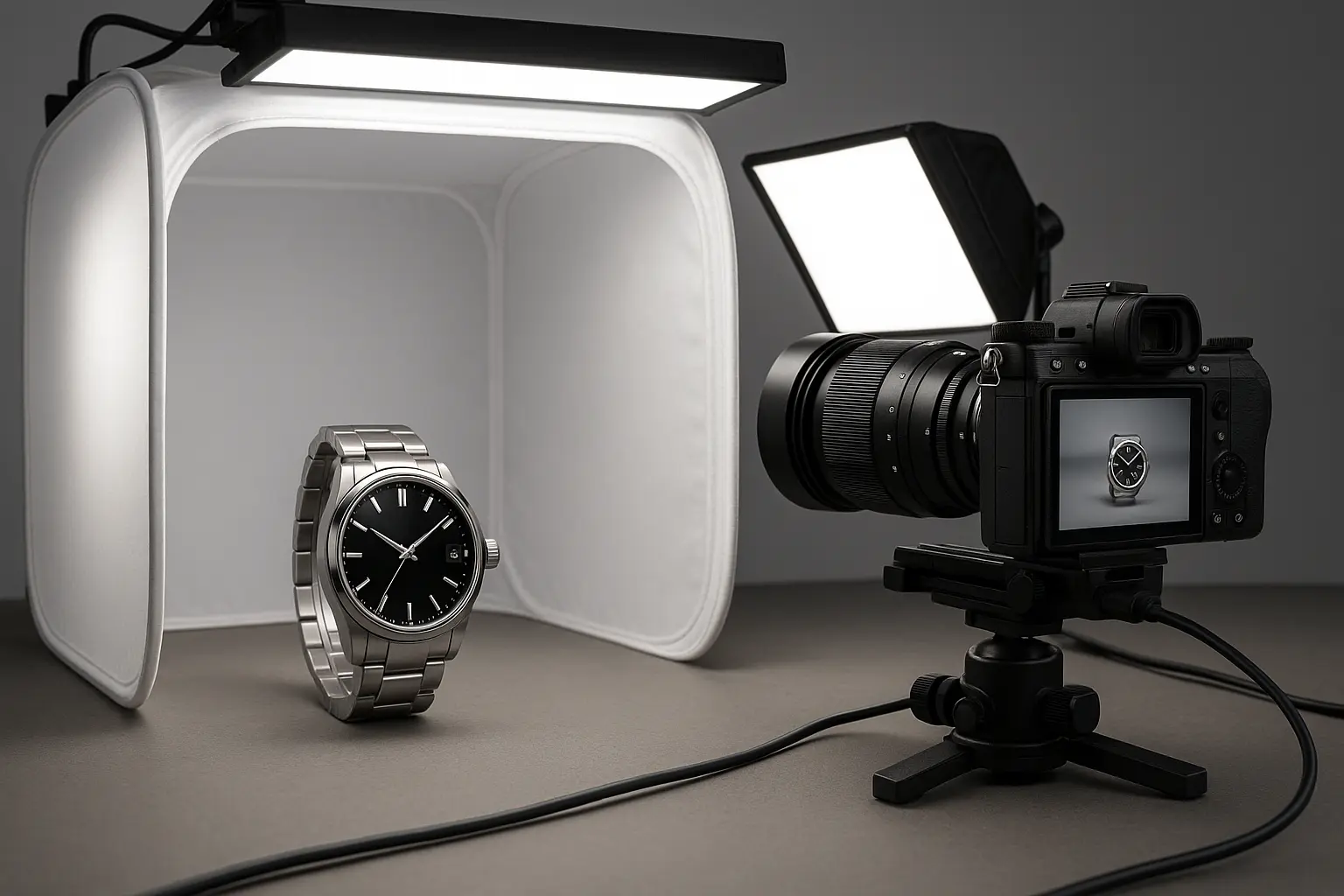
- Control reflections: Use diffusion tents, softboxes, and polarizing filters; angle lights to avoid specular hotspots on glossy packaging.
- Calibrate color: Use a gray card and a color checker. Build a custom camera profile for consistent ecommerce color accuracy.
- Keep ISO low and aperture optimal: For macro, diffraction can soften images at very small apertures. On high-resolution sensors, apertures around f/5.6–f/8 (full-frame) often balance sharpness and depth of field; rely on stacking instead of stopping down excessively.
- Tether your session: Evaluate focus, dust, scratches, and color on a calibrated monitor in real time to minimize reshoots.
Budget and Value Considerations
- Best overall detail and ecosystem: Sony A7R V with FE 90mm Macro.
- Best color accuracy with versatile macro lens: Canon EOS R5 with RF 100mm Macro.
- Best sharpness-to-price ratio: Nikon Z7 II with Z MC 105mm Macro.
- Ultimate detail for luxury products: Fujifilm GFX 100S (with macro accessories for true 1:1).
- Cost-effective high-detail setup: Fujifilm X-T5 with XF 80mm Macro or Laowa 65mm 2x.
Final Thoughts
The “best” camera is the one that balances resolution, color accuracy, focus stacking support, and lens ecosystem for your product category. For most studios, a high-resolution full-frame mirrorless body paired with a premium 90–105mm true macro lens delivers exceptional results with efficient workflow. If you specialize in luxury goods or high-end print, medium format can offer a tangible leap in tonality and micro-contrast, at the cost of speed and budget.