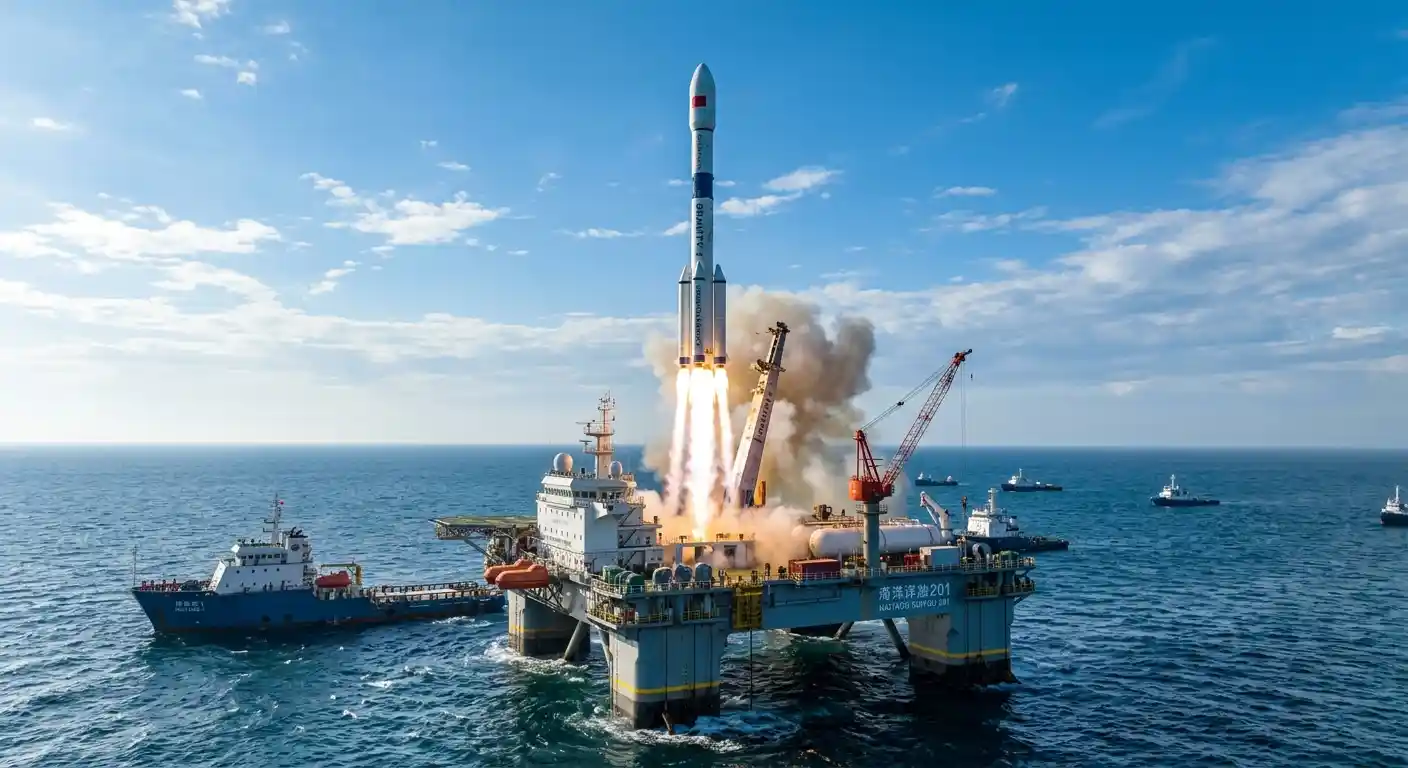

China’s Gravity-1 Y3 Launch Sends Nine Satellites Into Orbit
China has reached a notable milestone in commercial spaceflight after the Gravity-1 Y3 rocket launched nine satellites from a mobile platform in the East China Sea. OrienSpace, the Chinese private space company behind the mission, lifted off from waters near Shanghai on 16 September 2026. The launch placed eight Qianfan broadband satellites and one EUHT technology test satellite into their planned orbits.
The mission matters because it connects sea-based rocket launches with the rapid expansion of a low Earth orbit broadband network. It also shows how commercial launch providers are developing new ways to deliver large payloads beyond traditional land-based spaceports.
A Record Payload From a Maritime Launch Platform
Gravity-1 Y3 carried a net payload exceeding three tonnes and delivered the satellites to an altitude of approximately 800 kilometres. According to the report, both figures represent new Chinese records for a single sea-based launch. The result demonstrates that a mobile launch platform can support medium and large satellite missions while operating away from a fixed inland facility.
A sea launch gives mission planners more freedom. Operators can move the platform toward a location that better suits the target orbital path. This flexibility can reduce the need for complex trajectory changes after liftoff, while launching over open water can limit the risk to populated areas. These advantages make maritime launch operations increasingly relevant as satellite constellations demand frequent and reliable deployment services.
Why the Qianfan Constellation Matters
Eight spacecraft from the mission joined China’s Qianfan constellation, a planned low Earth orbit satellite internet system. The network aims to provide broadband connectivity from space and is designed to compete in the same expanding market as SpaceX’s Starlink. Qianfan reportedly targets more than 15,000 satellites by 2030, making launch capacity a central part of its long-term strategy.
The satellites used different configurations, including a stacked-satellite assembly and flat-panel spacecraft. That combination increased the demands on the rocket’s separation systems. After reaching orbit, the vehicle needed to release several payloads accurately and in the correct sequence. Successful deployment therefore reflected not only launch power but also careful mission integration and multiple-separation control.
A Specific World First
The mission received attention as the world’s first sea-based mobile launch dedicated to connecting satellites with a low Earth orbit broadband constellation. This description needs careful context. It does not mean that China conducted the first sea launch in history, nor does it mean that Gravity-1 had never launched from the sea before. Instead, the distinction applies to the mission’s specific purpose: deploying satellites for a large broadband network from a mobile maritime platform.
The flight also represented OrienSpace’s first launch dedicated to a major low Earth orbit satellite internet constellation. The company completed the mission only 56 days after its July launch, highlighting the system’s ability to support a faster launch cadence. The latest flight marked Gravity-1’s fourth successful sea launch and its second far-sea mission.
Commercial Space Competition Intensifies
The achievement strengthens China’s commercial space sector, which is expanding across solid-fuel rockets, satellite manufacturing and constellation services. OrienSpace is also developing Gravity-2, a reusable liquid-propellant rocket designed to carry up to 21.5 tonnes into low Earth orbit. The vehicle remains under development, with its planned maiden flight expected in the fourth quarter of 2026.
If development stays on schedule, Gravity-2 could give the company a larger role in future satellite deployment. Reusability could also help reduce launch costs and increase operational flexibility, although those benefits will depend on testing, recovery performance and long-term reliability.
What the Mission Means for Global Connectivity
Satellite internet providers need dependable launch systems because broadband constellations require many spacecraft. A mobile sea launch can offer alternative orbital routes, reduce pressure on established launch sites and help operators respond to changing constellation requirements. It may also support national connectivity goals in regions where terrestrial broadband infrastructure remains difficult to build.
However, the expansion of low Earth orbit networks creates challenges. Operators must manage orbital traffic, coordinate radio-frequency use and limit the growth of space debris. More satellites can improve coverage and network capacity, but responsible design, tracking and end-of-life disposal remain essential for the sustainability of the orbital environment.
For the industry, the most important question now concerns repeatability. One successful mission proves capability, but a constellation requires a steady rhythm of launches, predictable costs and consistent satellite deployment. Qianfan’s progress will therefore depend on how quickly OrienSpace can maintain that rhythm while preserving safety, orbital accuracy and environmental responsibility during future sea-based missions over time.
Gravity-1 Y3’s successful sea launch marks an important step for China’s commercial space ambitions. By sending nine satellites to an 800-kilometre orbit, OrienSpace demonstrated the potential of mobile maritime launch operations for large satellite constellations. The mission adds momentum to Qianfan’s broadband plans and intensifies competition in the global satellite internet market.