
China’s fusion industry has reported a notable advance in the search for cleaner nuclear energy. ENN Group, a commercial technology company based in Langfang, Hebei province, says its EXL-50U spherical device achieved hydrogen-boron fusion reactions under high-parameter plasma control. The announcement matters because it represents the first hydrogen-boron fusion reaction that a commercial fusion company has achieved on its own device, according to the company. It also adds momentum to a research path that aims to produce energy with far fewer neutron-related challenges than conventional deuterium-tritium fusion.
The report deserves careful interpretation. A successful reaction is not the same as a commercial power plant, and the available announcement does not establish net electricity production, continuous operation, or economic viability. Nevertheless, the result could strengthen China’s position in advanced fusion research and encourage wider investment in neutron-free fusion technology.
What Is Hydrogen-Boron Fusion?
Hydrogen-boron fusion, also called proton-boron fusion or p-boron fusion, combines a hydrogen proton with a boron-11 nucleus. The reaction can produce helium nuclei, known as alpha particles, and energy without generating the high-energy neutrons associated with the dominant deuterium-tritium fuel cycle. Because alpha particles carry electric charge, engineers may eventually explore direct energy conversion instead of relying only on a hot blanket and steam turbine.
That potential explains the interest in aneutronic fusion. A neutron-free fusion reaction could reduce neutron activation in reactor materials, simplify some shielding requirements, and limit certain forms of radioactive waste. It could also support more compact energy systems if researchers solve the demanding engineering problems involved. However, “aneutronic” does not mean risk-free or automatically waste-free. Reactors still require advanced materials, radiation management, heat removal, diagnostics, and robust safety systems.
How the EXL-50U Device Works
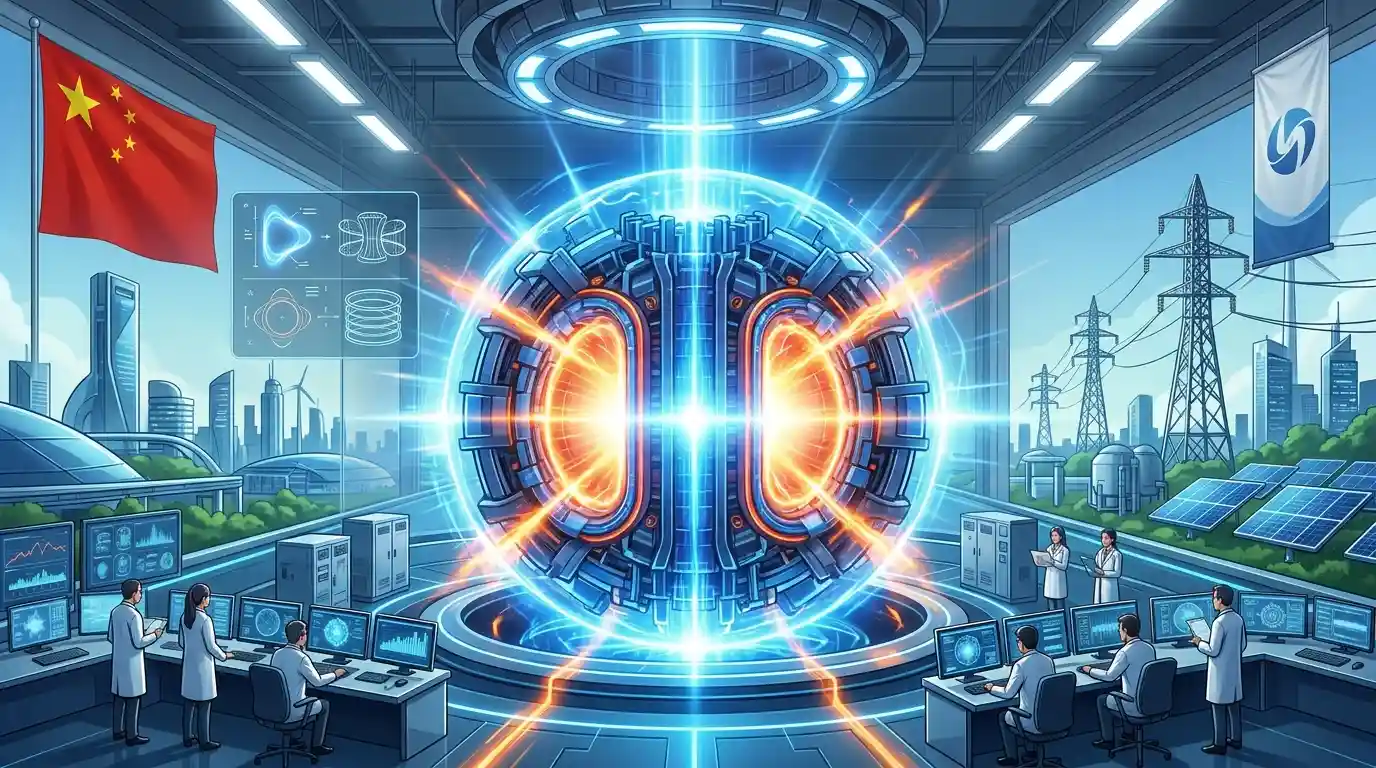
The EXL-50U is described as a compact spherical tokamak. A tokamak uses powerful magnetic fields to confine plasma, an electrically charged gas heated to extreme temperatures. The magnetic field keeps the plasma away from the reactor wall while researchers control its density, temperature, shape, and stability. In a spherical design, the chamber has a more compact, rounded geometry than a conventional doughnut-shaped tokamak.
Hydrogen-boron fuel creates a demanding scientific target. Compared with deuterium-tritium fusion, proton-boron reactions require much higher plasma conditions because the positively charged nuclei repel one another strongly. The device therefore must control energetic particles and maintain an intense plasma environment long enough for meaningful fusion reactions to occur. ENN’s reported high-parameter plasma control is important in this context, although independent technical data will be essential for judging the achievement’s scale and reproducibility.
Why This Differs from ITER’s Approach
Mainstream magnetic confinement research, including the International Thermonuclear Experimental Reactor in France, primarily uses deuterium and tritium. That fuel combination offers a comparatively accessible fusion reaction, which makes it central to many international reactor programs. Its major challenge involves energetic neutrons. Those neutrons can damage structural materials, activate components, and complicate maintenance and waste management.
Hydrogen-boron fusion seeks to avoid that central problem, but it introduces a harder ignition challenge. Researchers must create and sustain more extreme conditions while preserving plasma stability. In other words, proton-boron fusion may offer a cleaner reaction environment, yet it demands more advanced plasma physics and power engineering. The two approaches should therefore be viewed as parallel strategies rather than simple competitors.
China’s Commercial Fusion Ambition
ENN’s result also highlights the growing role of private companies in fusion energy development. Government laboratories and international projects continue to provide major scientific foundations, but commercial groups can move quickly from experimental concepts to specialized devices and industrial plans. ENN has presented the EXL-50U milestone as part of a broader route toward hydrogen-boron fusion commercialization in China.
The company’s reported strategy includes building the Helong-2 device, pursuing hydrogen-boron fusion power generation by 2030, and targeting lower-cost electricity before entering a demonstration-reactor stage before 2035. These dates are company goals, not guaranteed outcomes. Fusion programs often face delays because plasma control, superconducting magnets, first-wall materials, fuel handling, maintenance robotics, and grid integration can each create difficult technical bottlenecks.
Potential Benefits for Clean Energy
If engineers eventually make hydrogen-boron fusion practical, the technology could contribute to a diversified low-carbon electricity system. Fusion fuel research often emphasizes abundant materials, and boron is widely available compared with some specialized energy resources. A successful reactor could provide reliable power without combustion emissions during operation, complementing variable solar and wind generation.
The possible benefits extend beyond electricity. High-temperature fusion systems could support industrial heat, hydrogen production, desalination, or synthetic-fuel processes. Direct conversion of charged alpha-particle energy might improve efficiency in future designs. Yet these advantages remain prospective. Researchers must still prove that the full plant can produce more useful energy than it consumes, operate for long periods, withstand repeated thermal and radiation loads, and meet regulatory requirements.
The Challenges That Remain
The biggest challenge is not merely producing a few fusion reactions. A commercial reactor must sustain a stable plasma, recover heat, protect magnets and walls, remove impurities, and maintain components economically. Hydrogen-boron fusion also requires a temperature and confinement regime that may be more demanding than the deuterium-tritium pathway. Small experiments can demonstrate important physics without proving industrial performance.
Independent measurements will help clarify what the EXL-50U achieved. Useful evidence would include plasma temperature and density, reaction rate, confinement duration, input power, fusion output, diagnostic methods, repeatability, and peer-reviewed technical results. Transparent reporting can separate a genuine advance in plasma science from an exaggerated interpretation of a single milestone.
What This Milestone Means for the Future
The reported reaction does not mean that commercial fusion power has arrived. It does indicate that hydrogen-boron fusion has gained another experimental platform and that a private Chinese company has demonstrated confidence in a difficult fuel cycle. The development may stimulate competition, collaboration, and new research into magnetic confinement fusion, direct energy conversion, and advanced reactor materials.
The most realistic conclusion is measured optimism. ENN’s announcement represents a potentially valuable step in the long process of developing neutron-free fusion energy. The next tests will matter more than the headline: sustained operation, repeatable reactions, credible energy accounting, and progress toward the Helong-2 roadmap. If those milestones follow, hydrogen-boron fuel could become an important branch of future clean energy research rather than a laboratory curiosity.