
A Vanished Deep-Sea Brine Pool May Reveal How Early Life Survived
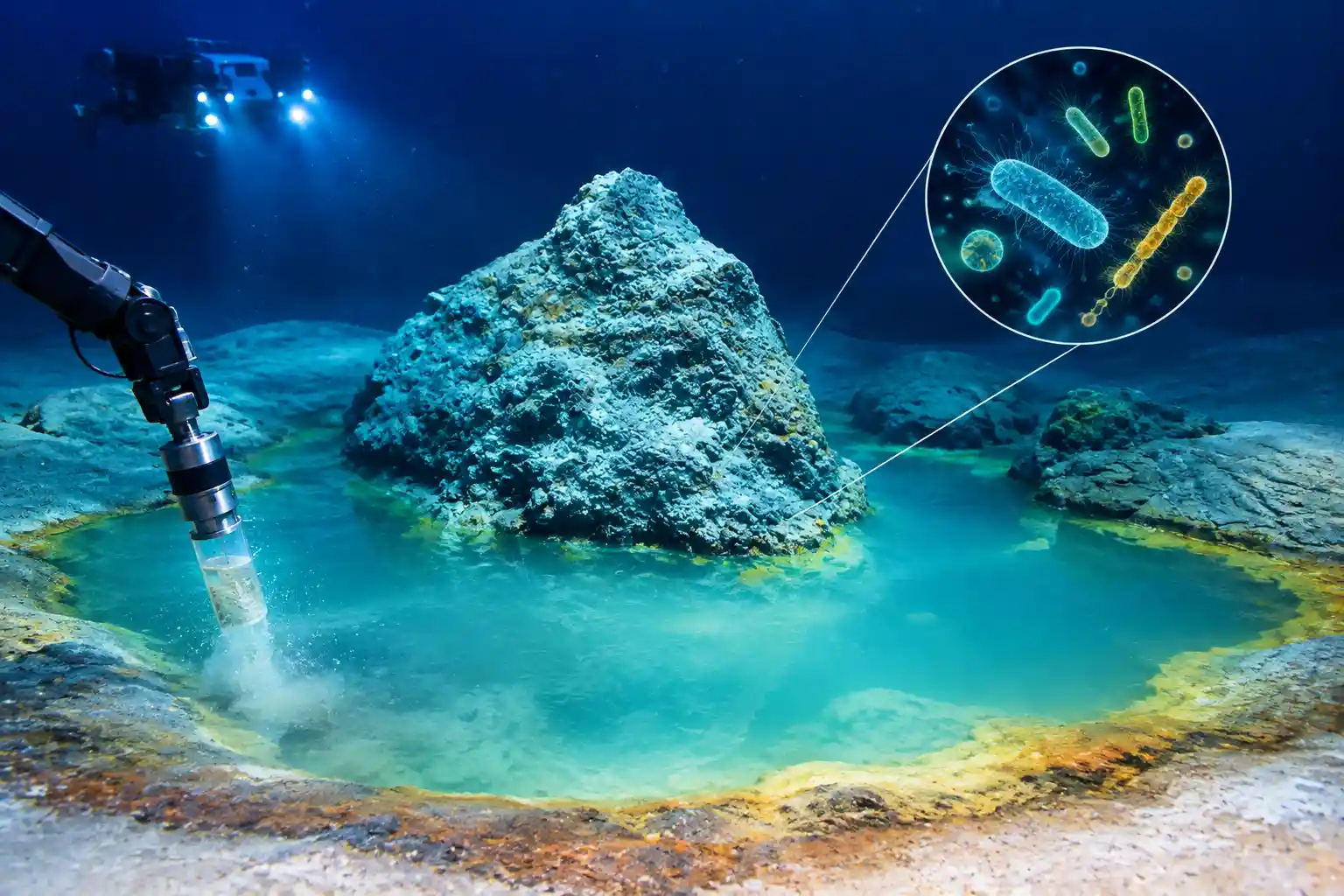
Scientists have discovered clues from a vanished deep-sea brine pool in the Red Sea that could reshape our understanding of early life. Although researchers once described these hyper-salty underwater basins as “death pools,” new sediment evidence suggests that extreme microbes once used them as natural laboratories for producing energy before oxygen transformed Earth’s atmosphere.
What Is a Deep-Sea Brine Pool?
A deep-sea brine pool is a dense, salty body of water that collects on the seafloor. Because the brine is heavier than ordinary seawater, it settles into depressions and forms a sharply defined underwater lake. Its chemistry can include very high salt concentrations, little or no oxygen, unusual acidity, and elevated levels of metals.
These conditions make brine pools hostile to most animals. However, extremophiles—microorganisms adapted to harsh environments—can thrive around their edges and inside their sediments. Their survival offers scientists a valuable window into microbial evolution, anaerobic metabolism, and the possible environments that supported Earth’s earliest organisms.
The Search Beneath the Red Sea
A research team from the University of Miami’s Rosenstiel School worked with OceanX during expeditions aboard the research vessel OceanXplorer between 2020 and 2023. Using the Mariner XL Argus remotely operated vehicle, the scientists investigated five deep-sea brine pools in the Red Sea region.
Two locations became especially important. The active NEOM pool lies in the Gulf of Aqaba at a depth of about 1,770 meters. The second site, called Hume Deep, sits roughly 1,370 meters below the northern Red Sea. Hume looked like an active brine pool, but it no longer contained its defining liquid layer.
Instead, researchers found a seabed depression with unusual sediment, mineral-rich discoloration, calcium-carbonate remains, and traces of small marine animals. These features indicated that Hume once supported a dense brine environment. The researchers estimate that the extinct pool existed between approximately 2,000 and 16,000 years ago.
Microbes That Make Energy Without Oxygen
The most important discovery concerns how these microorganisms may have survived. In the absence of abundant oxygen, some microbes appear to use chemical reactions involving minerals rather than relying on familiar oxygen-based respiration. They can oxidize dissolved manganese and iron, turning chemical energy into a usable biological resource.
The team detected unusual members of the Myxococcota group and Nitrospira, along with organisms associated with the Candidatus Brocadiae lineage. By examining genetic material, scientists could identify which organisms lived in the active pool. Metatranscriptomic analysis went further: it showed which genes were active and helped reveal how the microbes functioned.
This distinction matters. Finding microbial DNA shows that an organism may be present, but active genes provide stronger evidence about what it is doing. In this case, the results suggest that mineral oxidation powered microbial communities in a dark, oxygen-poor habitat.
A Model for Prehistoric Earth
The Red Sea discovery does not prove that the same organisms directly created Earth’s first life. It does, however, provide a modern analogue for ancient environments that existed before the Great Oxidation Event. Between about 2.4 and 2.1 billion years ago, oxygen began accumulating dramatically in Earth’s atmosphere and oceans.
Before that transition, early microorganisms needed alternative ways to obtain energy. Chemical gradients, volcanic minerals, iron, sulfur, and manganese may have supplied the fuel. The extinct Hume brine pool demonstrates how a microbial ecosystem can operate in extreme conditions without depending on sunlight or plentiful oxygen.
That finding supports a broader idea in astrobiology. If life can survive intense salinity, darkness, pressure, and oxygen scarcity on Earth, similar microbial communities might also exist in subsurface oceans or mineral-rich environments elsewhere in the solar system. Brine pools therefore help researchers identify possible biosignatures beyond our planet.
Why the Sediments Matter
Sediment preserves more than fossils. It also records the chemical history of an environment. At Hume Deep, layers contained calcium-carbonate skeletons and organic material, while the surrounding deposits held unusual concentrations of manganese, iron, molybdenum, and copper. Some metals reached levels more than 100 times higher than those in nearby sediments.
These deposits may reflect the activity of microbes that concentrated metals as they carried out metabolism. The result could improve scientists’ ability to locate other extinct brine pools that no longer contain visible brine. It may also inform research into critical minerals used in clean-energy technologies.
Scientists still need to determine exactly how much of the metal enrichment came from biology, geology, or the interaction between both processes. That caution matters because a compelling analogy is not the same as a complete reconstruction of ancient Earth.
What This Discovery Really Tells Us
The vanished pool’s greatest lesson is not that life prefers deadly places. It is that life can exploit chemical opportunities almost anywhere. Microbes do not need sunlight, oxygen, or comfortable temperatures if their surroundings provide an energy gradient and the right elements.
The findings also highlight the importance of combining disciplines. Marine geology reveals the basin’s history, geochemistry identifies the minerals, genomics detects the organisms, and metatranscriptomics shows their activity. Together, these methods transform an empty-looking depression into a record of a former living system.
Future expeditions may search for other extinct deep-sea brine pools in ancient salt basins. Each site could preserve a different stage of microbial adaptation. As exploration technology improves, these hidden habitats may help scientists understand how metabolism evolved long before complex life and oxygen-rich ecosystems appeared.
A Careful Look at the Evidence
The study shows why scientists must distinguish observation from interpretation. Researchers observed an active pool, analyzed sediment from a brine-free site, and measured microbial genes and minerals. The evidence strongly supports a connection between extreme microbes and chemical energy, while the link to primordial life remains a hypothesis. That balance keeps the discovery exciting without overstating what the data can prove.
Amazon Product Recommendation
For readers who want a broader visual introduction, The Deep Ocean: Life in the Abyss is a strong companion to this topic. The illustrated book explains deep-sea ecosystems, extreme pressure, cold seeps, hydrothermal vents, and the organisms that inhabit the abyss. It is available on Amazon.com, but price and stock can change.