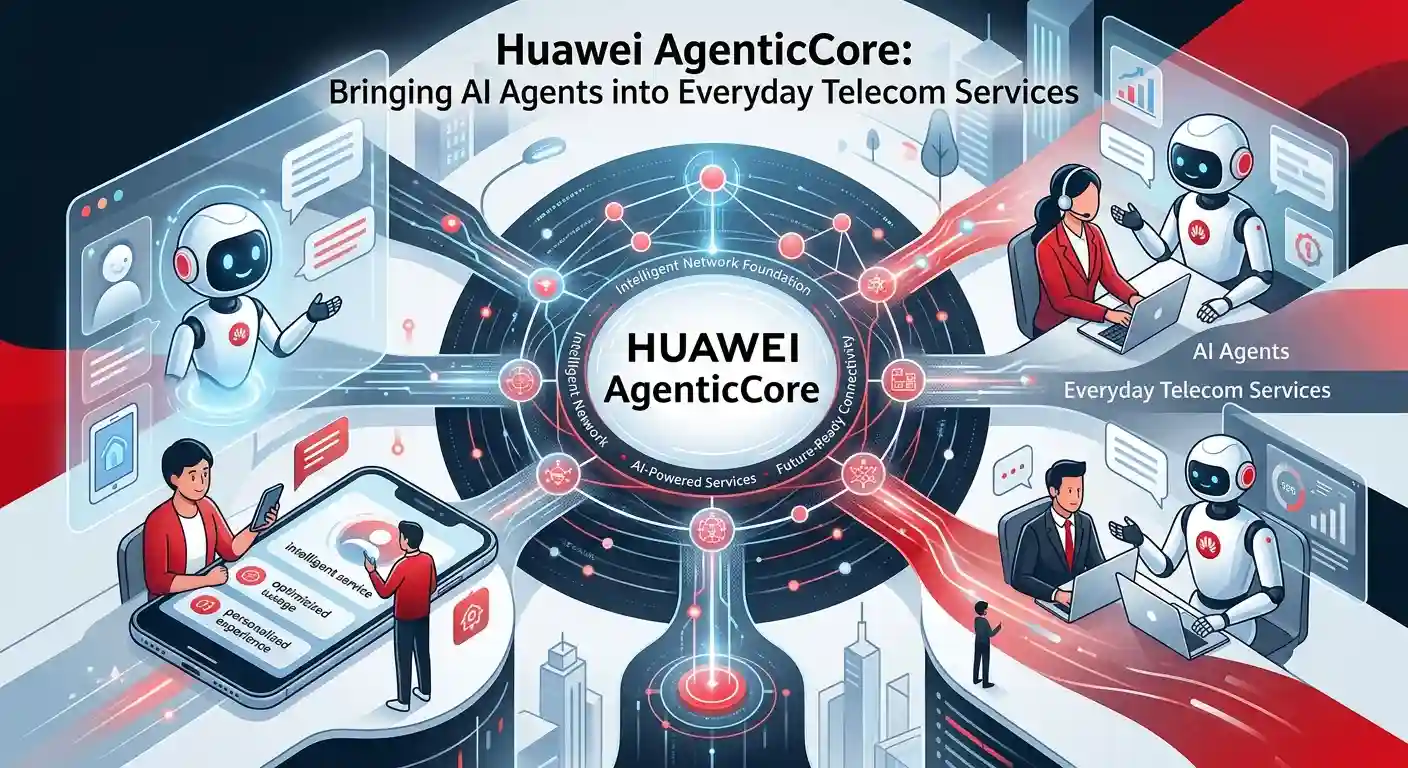

Huawei introduced AgenticCore at MWC Barcelona 2026 to help telecom operators rethink how their networks serve people, households, and businesses. Rather than treating artificial intelligence as an isolated feature, the solution connects service intelligence with the core network. Its central idea is terminal-network-business synergy: devices, network capabilities, and services working together around user needs.
The announcement outlines a practical direction for AI-centric networks. Huawei aims to improve familiar services first, including voice calls, mobile internet, and home broadband, while preparing operators for broader communication between intelligent agents.
What Is Huawei AgenticCore?
Huawei AgenticCore combines service solutions, coordination capabilities, and intelligent infrastructure. The company organizes the offering around three service-enabling solutions, two synergy capabilities, and one infrastructure foundation. Together, these elements target a more personalized relationship between subscribers and their connectivity services.
According to Huawei, the platform builds user-centric memory and interprets service intent across consumer and household scenarios. In practical terms, this approach seeks to make network services more responsive to what users want, rather than relying only on conventional connectivity delivery.
Huawei presented the solution on March 2, 2026, with George Gao, President of its Cloud Core Network Product Line, introducing the strategy.
AI Calling Targets Clearer, More Useful Conversations
Voice remains an important operator service, and Huawei places it near the center of its AgenticCore roadmap. Its AI Calling solution includes AI noise cancellation across mobile communication generations and usage scenarios, according to the announcement.
The intended benefit is straightforward: reduce distracting sound so people can communicate more clearly. Huawei also describes interactive calling capabilities that address communication barriers and support multiple tasks within a single call.
These features position calling as more than an audio connection. However, the announcement does not provide independent performance measurements, so readers should distinguish Huawei’s stated capabilities from externally verified results.
Personalized Experiences Create a Different Value Proposition
The Intelligent Personalized Experience solution, or IPE, differentiates network experiences by user or service. Huawei frames this capability as a route from traffic monetization toward experience monetization.
That distinction matters because data consumption alone does not fully describe service quality. People judge connectivity through the activities they perform and the consistency they experience. A more personalized service model therefore shifts attention toward relevant outcomes rather than simply larger data allowances.
Huawei does not publish detailed commercial packages or pricing in this announcement. Operators would still need to translate the proposed capabilities into clear offers that customers can understand and evaluate.
The AI Home Hub Extends Intelligence into Households
AgenticCore also includes an AI home hub designed to deliver proactive services with an emotional dimension. Huawei identifies companionship for older adults and learning assistance for children as potential applications.
This expands the discussion beyond faster broadband. The home connection becomes part of a service environment that can support different household needs.
These examples describe Huawei’s intended use cases, not evidence of educational or health outcomes. Responsible implementation would require careful attention to user consent, privacy, and appropriate boundaries, especially when services interact with children or vulnerable people. Those considerations remain important even when an announcement emphasizes convenience and personalization.
How AISF and ACN Connect the Architecture
Huawei identifies Artificial Intelligence Service Function, or AISF, as one of the solution’s two coordination capabilities. AISF provides user-centric service agents that integrate business-to-consumer and business-to-home services.
The second capability, Agent Communication Network, or ACN, supports agent communication across domains and ecosystems. Huawei describes an agent-based routing architecture and skill-based routing that help agents connect according to their capabilities.
Together, these components explain the purpose of terminal-network-business synergy. The architecture seeks to connect user intent, service functions, and agent interactions instead of leaving each element in a separate operational silo. This coordination forms a central part of Huawei’s vision for future agent networks.
Intelligent Infrastructure Supports Network Evolution
Huawei’s infrastructure foundation combines diverse computing resources, terabit-level inference bandwidth, and agent-based autonomous troubleshooting. The company presents these capabilities as preparation for the continuing evolution of AgenticCore.
For operators, this highlights an important dependency: intelligent services need suitable infrastructure behind them. Adding agents at the application layer alone does not explain how a network will coordinate their communication or support growing inference demands.
The announcement places AgenticCore within Huawei’s wider direction for 5G-Advanced, future 6G evolution, and autonomous networks. It does not establish a universal deployment timetable or demonstrate that every proposed capability already operates at commercial scale.
Why AgenticCore Deserves Attention
Huawei AgenticCore brings several telecom priorities into one framework: better calling, personalized mobile experiences, household assistance, and coordinated agent connectivity. Its significance lies in connecting those priorities rather than presenting AI as a standalone upgrade.
The next test will involve implementation. Operators will need to assess integration requirements, service reliability, governance, and customer value. Huawei’s announcement provides a strategic blueprint; practical deployments and measurable results will determine how convincingly that blueprint improves everyday connectivity.
For readers following telecom innovation, the key question is whether this coordinated approach can turn complex network intelligence into services that feel simpler, clearer, and more useful.
Source: Huawei Launches AgenticCore Solution: Building an Agent Network with Terminal-Network