
Light Field Cameras and Post-Capture Refocusing
Light field cameras are changing the way we think about photography because they don’t just record a flat image—they capture information about light itself. This extra layer of data makes a powerful feature possible: post-capture refocusing, meaning you can choose the point of focus after the photo has already been taken. For creators, researchers, and visual storytellers, this is more than a novelty. It’s a different imaging approach that can improve creative flexibility, speed up workflows, and enable computational photography techniques that standard cameras cannot easily replicate.
What is a light field camera?
A traditional camera records the intensity (brightness and color) of light hitting each pixel on the sensor. It’s like collecting a single “slice” of the scene from one viewpoint, where focus decisions are mostly finalized at capture time. A light field camera tries to capture more: not only how much light arrives, but also the direction those rays are traveling from. That directional data helps the camera software understand how light interacts with the scene in 3D space.
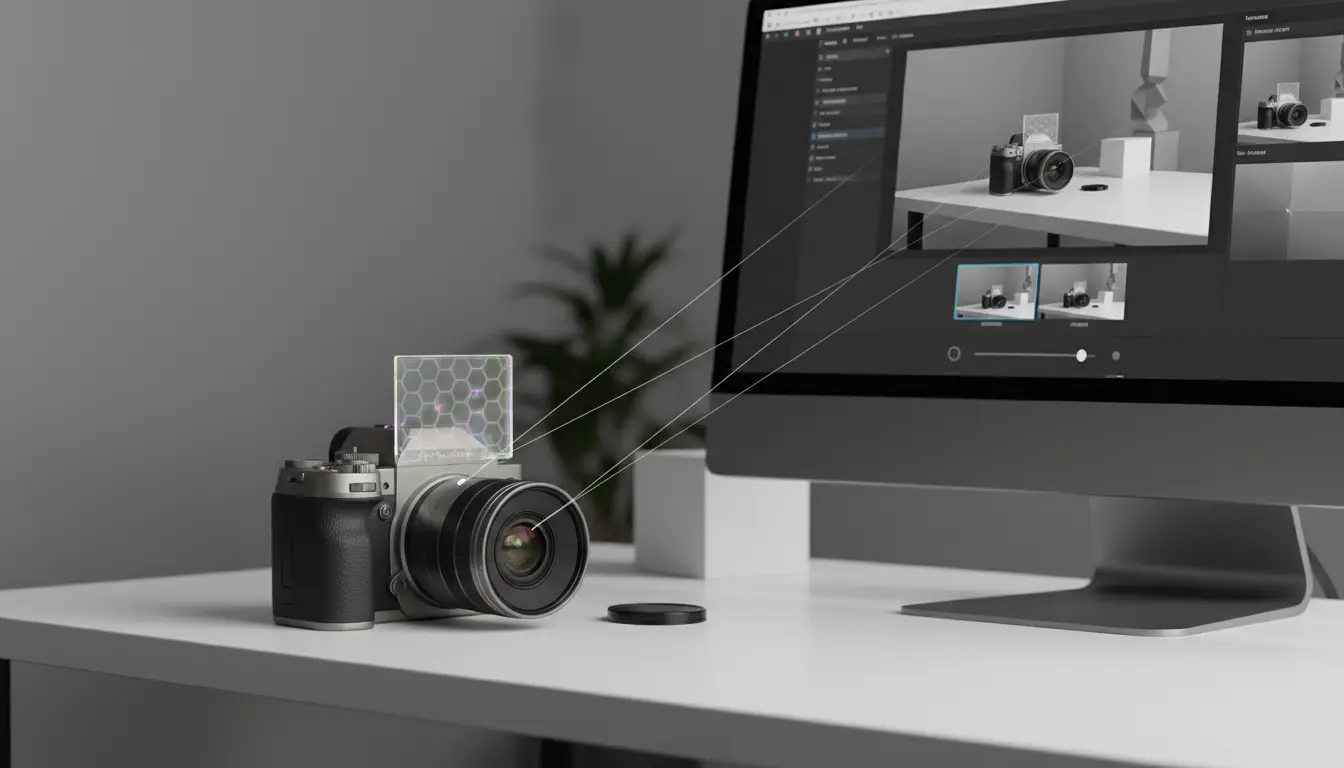
To collect this information, many light field camera designs use a microlens array positioned in front of the image sensor. Each microlens gathers light from slightly different angles, creating a structured dataset that can later be processed to reconstruct images with different focus planes. In other words, the camera records a “light field,” which is essentially a richer model of the scene than a normal photograph.


How post-capture refocusing works (in plain terms)
When you refocus a standard photo in editing software, you’re mostly faking it—often via blur masks or AI-based depth estimation. With a light field camera, refocusing is based on captured ray direction data. The system can computationally “re-render” the image as if the lens had been focused at a different distance.
A simplified way to think about it:
- The camera captures many micro-images (from the microlenses), each representing the scene from a slightly different angle.
- Software analyzes how features shift between these angles (a concept related to parallax).
- From that shift, it estimates depth relationships and can synthesize a photo focused at different distances.
This is why post-capture refocusing from light field data can look more physically grounded than artificial blur added to a conventional image—because it is driven by the camera’s underlying sampling of the light rays.
Why this matters: real benefits beyond “cool tech”
Post-capture refocusing is the headline feature, but the bigger value is creative and technical flexibility:
- You don’t miss the shot due to focus error. In fast-moving situations (events, documentary, wildlife), focus mistakes can ruin otherwise great images. A light field capture can give you a second chance.
- Better experimentation in composition. You can decide later whether the foreground subject or the background detail should be tack-sharp.
- Assisted depth-based editing. The depth cues in light field data can support segmentation, selective adjustments, and computational effects.
- Research and industry use cases. In robotics, imaging science, and quality inspection, extra scene structure is valuable for measurement and analysis.
The trade-offs: what you “pay” for refocusing freedom
Light field cameras offer unique capabilities, but they come with compromises:
1) Resolution trade-off
Because the sensor’s pixels are effectively divided to capture angular information, the final refocused output may have lower spatial resolution compared to a standard camera sensor of the same size. You’re trading some “detail” for “flexibility.”
2) Low-light performance
Depending on design, capturing angular data can reduce the amount of light per effective image pixel, which may increase noise in dim scenes. Strong lighting or careful exposure can help, but it’s a consideration.
3) Workflow and processing
Light field images can require specialized processing software, and files may be heavier. Refocusing and rendering can take time depending on your hardware and the complexity of the scene.
4) Limits to refocusing realism
Refocusing works best when the scene has enough texture and depth cues. Highly reflective surfaces, extreme transparency (glass), or very repetitive patterns can sometimes confuse depth estimation and produce artifacts.
How light field refocusing compares to “portrait mode” depth blur
Smartphone portrait mode typically uses a mix of stereo cameras, LiDAR (on some devices), and machine learning to estimate depth. Then it simulates background blur. Results can be impressive, but edges (hair, glasses, complex objects) can look unnatural, and blur may not match real optics.
Light field refocusing aims to be closer to an optical process because the camera captures more information about ray directions. However, it still relies on computation—and performance depends on sensor design, scene complexity, and the quality of reconstruction algorithms.
So the comparison is less “one is always better,” and more: portrait mode is convenience-driven simulation, while light field refocusing is data-driven reconstruction.
Best scenarios for light field cameras (and when to avoid them)
Best for:
- Product photography where you want flexibility across focus planes
- Creative storytelling where you want to “choose” focus later
- Educational or research projects exploring computational photography
- Controlled shoots where lighting and composition can be optimized
Less ideal for:
- Extremely low-light environments without additional lighting
- Work requiring maximum native resolution and micro-detail
- Fast turnaround pipelines that can’t accommodate extra processing steps
Practical tips for getting better refocus results
If you’re aiming for professional-looking post-capture refocusing, these habits help:
- Use strong, directional light when possible to keep noise low and textures clear.
- Include depth separation in your scene (foreground-midground-background) so refocusing is visually meaningful.
- Avoid overly reflective, transparent, or highly repetitive surfaces when refocus quality is critical.
- Keep your subject textured (fabric, hair detail, patterns) because depth inference often relies on feature tracking.
- Stabilize the camera to reduce motion blur, which can degrade reconstruction.
The future: where light field imaging is heading
Light field imaging sits at the intersection of optics and computation. As sensors improve and algorithms get faster, we’ll likely see better effective resolution, smarter depth reconstruction, and more accessible workflows. It’s also reasonable to expect more hybrid systems—combining traditional imaging pipelines with light field-like angular sampling and AI-driven reconstruction.
For creators, the key takeaway is simple: light field cameras represent a shift from “capture a final image” to “capture a rich dataset and decide later.” Post-capture refocusing is one expression of that shift, and it’s a strong example of how computational photography can expand creative options.