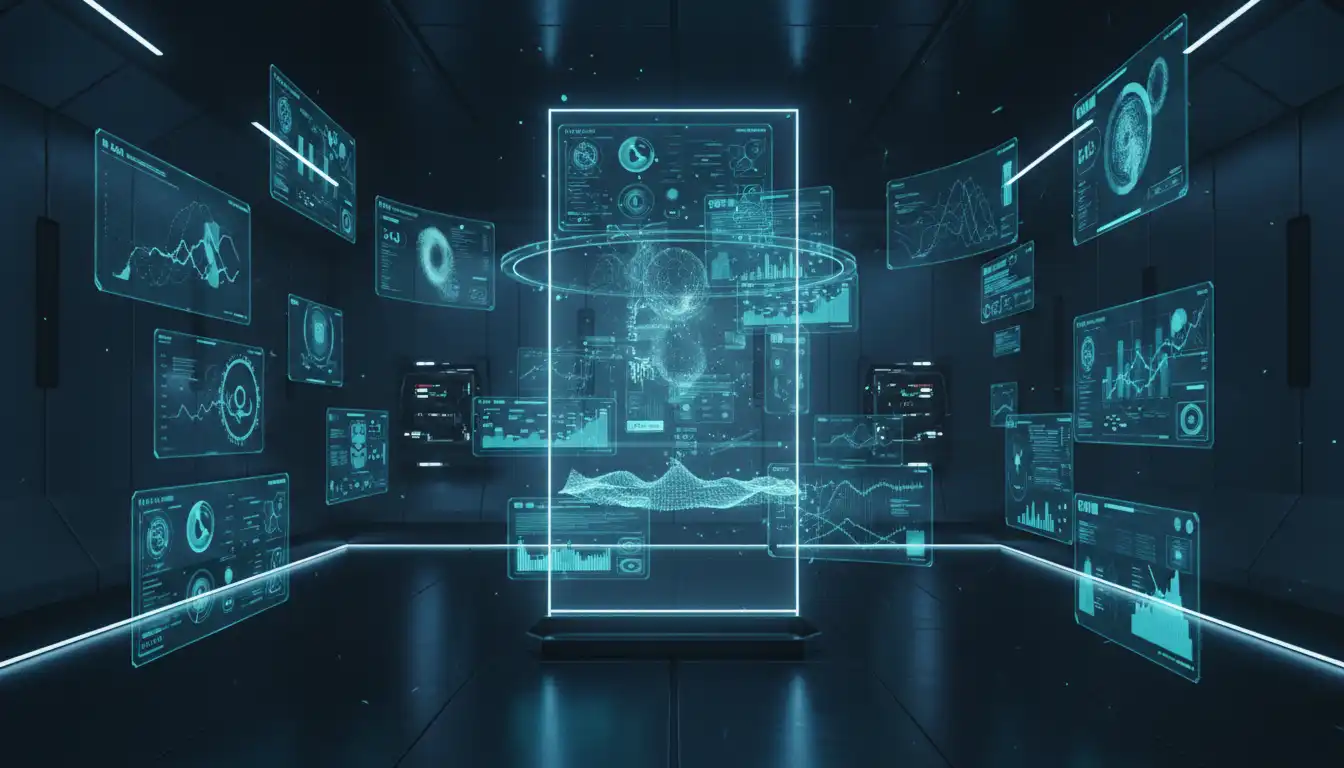

XR Holographic Displays: The Future of Borderless Visual Experiences
Extended Reality (XR) holographic displays are redefining how we see and interact with digital content. By projecting three‑dimensional images that appear to float in mid‑air, XR holographic screens remove the need for traditional frames, bezels, or physical monitors. This “borderless visual experience” opens the door to more immersive entertainment, more intuitive design workflows, and more engaging retail and training environments.
At their core, XR holographic displays combine elements of augmented reality (AR), virtual reality (VR), and mixed reality (MR). Unlike standard flat screens, these systems create volumetric or depth‑rich visuals that can be viewed from multiple angles. The result is a sense of presence: objects appear as if they occupy real space, even though they are entirely digital. As display hardware, sensors, and rendering engines improve, these holographic interfaces are becoming more realistic, more responsive, and increasingly accessible to businesses and consumers.
How XR Holographic Displays Work
XR holographic screens typically rely on a combination of advanced optics, depth‑sensing cameras, eye‑tracking, and real‑time 3D rendering. Light field or holographic panels project slightly different images to each eye, recreating natural depth perception without the need for heavy headsets in some configurations. In other setups, lightweight XR headsets overlay holographic content onto the user’s field of view, precisely anchored to the physical world.
A key advantage of this technology is the elimination of visible frames. Traditional displays confine content inside a fixed rectangle; XR holographic solutions allow visuals to appear as if they are emerging directly from the environment. Digital prototypes can sit on a real‑world desk, architectural models can rise from a conference table, and interactive data dashboards can float in front of decision‑makers. This borderless design philosophy leads to more intuitive interaction and better spatial understanding of complex information.
Applications Across Industries
The potential uses of XR holographic displays span almost every sector. In entertainment and gaming, holographic interfaces enable players to interact with characters and environments that extend beyond the TV or monitor. Storytelling becomes more immersive when scenes unfold in the space around the viewer, not just on a flat surface.
In design and engineering, XR holographic displays are transforming prototyping and collaboration. Product designers can inspect life‑size 3D models, test variations in real time, and detect flaws before building physical samples. Automotive and aerospace teams can visualize internal components, simulate motion, and make faster decisions during early development stages. Because the visuals appear in three dimensions, communication between engineers, designers, and stakeholders becomes clearer and more efficient.
Healthcare is another promising field. Surgeons can use holographic guidance systems to visualize patient anatomy in 3D during procedures, improving precision and reducing risks. Medical students can learn using anatomically accurate holograms instead of relying solely on textbooks or cadavers. Complex medical concepts become easier to grasp when they are displayed as fully interactive 3D models.
In retail and marketing, XR holographic displays help brands stand out and engage customers. Stores can showcase products as holograms, allowing shoppers to explore features, configurations, and colors without physical inventory. Interactive holographic assistants can answer questions, provide recommendations, and demonstrate products, all while maintaining a futuristic, premium brand image. For e‑commerce, XR experiences can reduce return rates by giving customers a clearer understanding of size, fit, and functionality.
Education and corporate training also benefit from this technology. Instructors can project holographic simulations of historical events, scientific processes, or mechanical systems into the classroom. Learners absorb information more effectively when they can walk around and interact with objects, rather than passively watching a slideshow. In enterprise settings, holographic training scenarios allow employees to practice complex tasks in a safe, repeatable, and measurable environment.
Benefits of Borderless Visual Experiences
The main promise of XR holographic displays is a borderless visual experience that feels natural and intuitive. Removing physical frames changes how people relate to digital content. Instead of looking at information locked behind glass, users experience it as part of their surroundings. This improves spatial comprehension, memory retention, and emotional engagement.
Borderless visuals also encourage collaboration. Multiple people can gather around the same holographic scene, pointing to details, annotating in real time, and discussing options. Remote participants can join via XR collaboration platforms, sharing synchronized holograms across locations. This makes distributed teamwork more effective and can significantly reduce travel costs and project delays.
Another important benefit is efficiency. By visualizing complex data in 3D, businesses can discover patterns and insights that are hard to see on flat charts. For example, manufacturing plants can view holographic digital twins of their production lines, monitoring performance metrics layered onto physical equipment. Urban planners can explore holographic city models that incorporate traffic, energy use, and environmental data, leading to better long‑term decisions.
Challenges and Considerations
Despite their promise, XR holographic displays face several challenges. Hardware remains relatively expensive, especially for large‑scale installations or high‑resolution light field panels. Content creation is another hurdle; producing high‑quality holographic assets requires specialized 3D skills, tools, and workflows. Companies must invest in training or partner with experienced XR studios to build compelling experiences.
User comfort and ergonomics are also crucial. Head‑mounted devices need to be lightweight, well‑balanced, and adjustable to minimize strain. Stand‑alone holographic displays must account for viewing angles, brightness, and ambient lighting conditions. As the industry matures, improvements in optics, processing power, and battery life are gradually addressing these limitations.
Privacy and security cannot be overlooked. XR holographic systems often rely on sensors, cameras, and constant tracking of user movements. Organizations must ensure that sensitive visual data and user behaviors are handled securely, following best practices and regulatory requirements.
The Road Ahead for XR Holographic Screens
As XR hardware becomes more compact and affordable, holographic displays are expected to move from niche installations to mainstream use. Advances in AI‑driven rendering, eye‑tracking, and foveated display techniques will boost performance while reducing power consumption. Cloud‑based XR streaming will make high‑fidelity holograms accessible even on lightweight devices, enabling large‑scale deployments in retail, education, and public spaces.
In the long term, XR holographic screens will likely blend seamlessly with smart environments. Walls, windows, and everyday surfaces may act as dynamic display canvases, revealing holographic information only when needed. Voice commands, hand gestures, and gaze will replace traditional input devices, creating a more natural relationship between humans and digital content.
For businesses, now is the time to experiment with pilot projects and proof‑of‑concept experiences. Early adopters can refine their strategies, build internal expertise, and position themselves ahead of competitors. As customers increasingly expect richer, more interactive digital experiences, XR holographic displays will become a key differentiator in how brands communicate, educate, and sell.
By embracing borderless visual experiences, organizations can transform static information into living, spatial stories. XR holographic technology is not just an incremental upgrade over flat screens; it represents a fundamental shift in how we visualize ideas, products, and data. The companies that learn to harness this shift today will help define the next generation of digital interaction.