
If you manage data across multiple cloud platforms, Rclone is the power tool you’ve been looking for. Think of it as a universal remote for your cloud storage—one command-line utility that connects to over 70 providers, including Google Drive, Dropbox, OneDrive, Amazon S3, Backblaze B2, Wasabi, and more. In this comprehensive guide, we’ll show you why Rclone is the smartest way to sync, migrate, and back up data between clouds. You’ll learn how to accelerate transfers, cut costs, and safeguard your data—without vendor lock-in. Whether you’re a solo creator, an agency, or an enterprise, Rclone helps you move faster with fewer headaches and complete control.
Focus keyword: Rclone inter-cloud transfer guide
Why Rclone for inter-cloud transfers?
- Vendor-agnostic flexibility: Rclone supports a vast list of cloud storage services with a consistent interface. No more learning a new tool for each provider.
- Speed and efficiency: With multi-threaded transfers, server-side copy, and bandwidth throttling, Rclone eliminates bottlenecks and gets data where it needs to be—fast.
- Reliability at scale: Checksums, integrity checks, retries, and resume support make Rclone suitable for large migrations and ongoing backups.
- Automation-ready: Schedule jobs, run headless, log everything, and integrate into CI/CD or cron for repeatable data workflows.
Core use cases that drive ROI
- Cloud-to-cloud migration: Move terabytes from Google Drive to OneDrive or S3 without downloading to your local machine, saving time and bandwidth.
- Cross-region redundancy: Mirror critical datasets between S3-compatible providers for disaster recovery.
- Hybrid workflows: Keep a working set in a “hot” cloud while mirroring archives to low-cost, cold storage.
- Team content operations: Sync shared folders across providers so teams and clients stay aligned without manual zipping or re-uploads.
Key features you’ll love
- Server-side transfers: When both clouds support it (e.g., S3 to S3-compatible), Rclone can instruct providers to copy directly, often at data-center speed and zero egress on your network.
- Sync and copy modes: Use “copy” for one-way migrations or “sync” to keep destinations perfectly mirrored (including deletions if desired).
- Filters and include/exclude rules: Move only what matters—file types, folders, size thresholds, and date ranges—to optimize cost and time.
- Encryption and checksums: Built-in crypt remotes can encrypt data at rest and in transit; hash checks ensure bit-perfect integrity.
- Bandwidth control and retries: Keep business continuity intact with rate limits during work hours and aggressive retries for flaky connections.
Simple workflow to get started
- Install Rclone: Available on macOS, Windows, and Linux. Use your package manager or download binaries from the official site.
- Configure remotes: Run “rclone config” and set up each cloud. Rclone guides you through OAuth or key-based auth.
- Test connections: List files with “rclone ls remote:bucket/folder” to confirm access.
- Run a dry run: Add “–dry-run” to preview actions before executing for real—an invaluable safety step.
- Execute and monitor: Start transfers with “rclone copy” or “rclone sync,” enable logs with “-v” or “-P” to see progress, speed, and ETA.
Example commands:
- One-way copy:
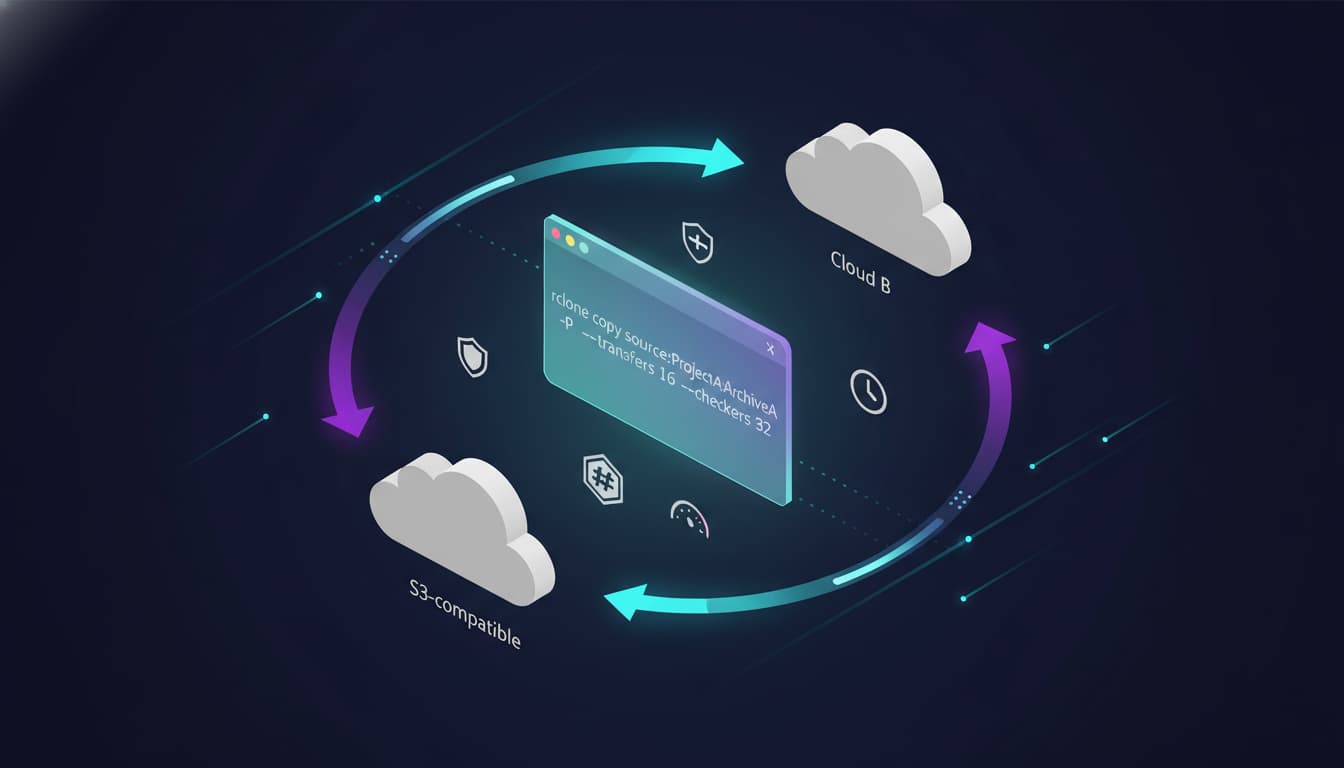
rclone copy sourceRemote:ProjectA destRemote:ArchiveA -P –transfers 16 –checkers 32 - Mirror sync (with delete):
rclone sync sourceRemote:Media destRemote:MediaBackup -P –delete-excluded - Filter by type:
rclone copy source: data: –include “*.csv” –max-size 2G -P - Encrypt at rest (using a crypt remote):
rclone copy source: cryptRemote:secure-data -P
Tip: For ultra-large transfers, increase parallelism with “–transfers” and “–checkers.” Use “–buffer-size” for throughput gains and “–drive-chunk-size” for Google Drive performance. Always test with a subset first.
Performance best practices
- Prefer server-side where possible: For S3-compatible providers, add “–s3-server-side-encryption” if required and leverage intra-provider copy to avoid last-mile latency.
- Right-size concurrency: Start with transfers=8–16 and checkers=16–32; scale based on CPU, network, and provider quotas.
- Schedule during off-peak: Run heavy lifts overnight; throttle with “–bwlimit” during business hours.
- Chunking and chunk sizes: For Drive/OneDrive, larger chunks can boost speed, but watch API and memory limits.
- Use “–compare-dest” or “–size-only” for subsequent syncs when appropriate to skip hashing on unchanged data.
Data integrity and security
- Checksums: Enable hashing for providers that support it (e.g., MD5, SHA-1) to ensure end-to-end integrity.
- Verify with “rclone check”: Compare source and destination for mismatches post-migration—get a clear report of any discrepancies.
- Encryption: Use Rclone’s crypt to encrypt filenames and content before sending to untrusted or shared environments.
- Access control: Keep credentials secure, rotate keys regularly, and use least-privilege IAM roles for S3 or equivalent permissions for other clouds.
- Logging and audit: Run with “-vv” for debug logs during pilots; store logs centrally to audit who moved what and when.
Cost optimization strategies
- Minimize egress: Favor server-side copy within the same provider or between compatible endpoints to avoid outbound data charges.
- Tier-aware storage: Move infrequently accessed data to cold tiers like Glacier/Archive (where supported) and keep hot content in standard tiers.
- Smart filtering: Exclude temp files, caches, and duplicate archives. Consider compressing large directories beforehand if it reduces object counts.
- Incremental sync: After an initial full migration, run frequent small syncs to avoid massive periodic spikes and to keep bills predictable.
Automation and scale
- Cron jobs and schedulers: Automate nightly backups or weekly mirror jobs. Use exit codes to alert on failures.
- Policy-as-code: Store Rclone configs in secure version control (minus secrets) and template environments for consistent deployments.
- Observability: Pipe progress to dashboards or alerts. Track throughput, error rates, and time-to-completion so teams get early warnings.
- Team workflows: Wrap Rclone in scripts that validate inputs, notify Slack/Email on completion, and tag runs with job IDs for traceability.
Migrating from legacy tools
Switching from ad-hoc scripts or provider-specific sync apps to Rclone yields a unified workflow, predictable outcomes, and fewer brittle edge cases. You’ll gain:
- One command surface for all clouds
- Better performance tuning and reusability
- Sharper observability and audit trails
- Easier onboarding for new team members
Who benefits most?
- Media teams moving large libraries cross-cloud
- Data engineers replicating data lakes across regions/providers
- Agencies coordinating client assets across shared drives
- IT admins consolidating storage before a cloud contract change
- Researchers synchronizing datasets between institutional clouds and S3
Getting stakeholder buy-in
Position Rclone initiatives as cost and risk reducers:
- Faster time-to-migrate means lower downtime and fewer weekend cutovers
- Integrity checks reduce rework and support tickets
- Vendor independence prevents lock-in and negotiation pressure
- Consistent automation raises overall team productivity
Quick checklist before your first big transfer
- Confirm API limits and quotas on both clouds
- Choose copy vs sync deliberately; enable “–dry-run” first
- Decide on checksum policy; run “rclone check” after
- Set reasonable “–transfers/–checkers” and “–bwlimit”
- Enable logs and alerts; test a representative subset
With the right setup, Rclone turns multi-cloud complexity into a competitive advantage. You’ll move faster, pay less, and maintain verifiable control over every byte.