
Tesla’s 4680 Cells vs. LG & Panasonic: Who Will Dominate the U.S. EV Battery Supply Chain?
The race to dominate the U.S. electric vehicle (EV) battery supply chain is accelerating as Tesla, LG Energy Solution, and Panasonic invest billions of dollars into new technologies and domestic production. At the center of this competition lies Tesla’s 4680 battery cell — a next‑generation cylindrical cell that the company claims will offer higher energy density, lower cost per kWh, and improved manufacturing efficiency. Meanwhile, battery giants LG and Panasonic are working to secure their own positions through partnerships, capacity expansions, and advanced chemistries tailored to U.S. automakers.
This evolving landscape is not just about technology. It is about control: control over critical raw materials, manufacturing know‑how, long‑term supply contracts, and compliance with U.S. policy incentives such as the Inflation Reduction Act (IRA). The outcome will shape who leads EV adoption in North America over the next decade.
What Makes Tesla’s 4680 Cells So Important?
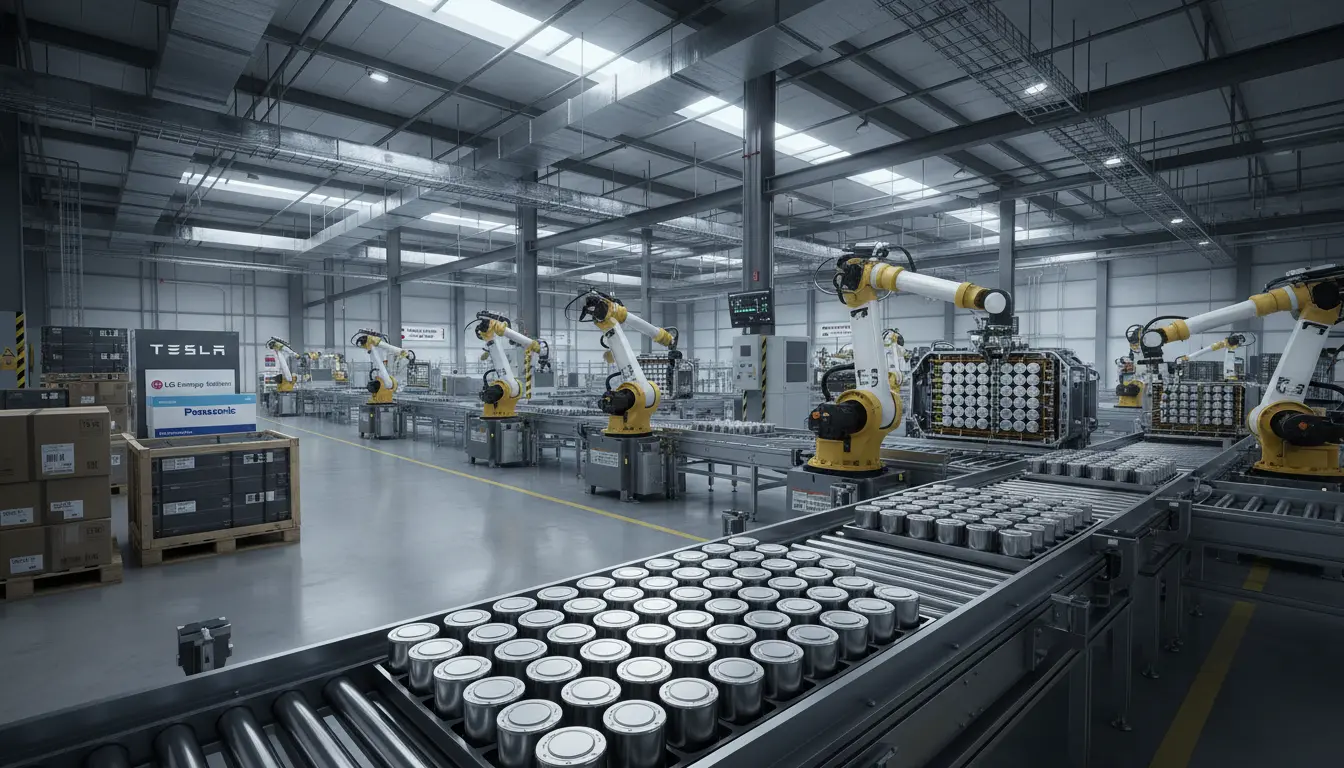
Tesla’s 4680 cells (46 mm diameter, 80 mm height) represent a shift from the company’s previous 2170 and 18650 cylindrical formats. The 4680 design promises several key advantages:
- Higher energy density
The larger format, combined with new electrode and tabless architecture, is designed to store more energy in the same or smaller pack volume. This can translate into:- Longer driving range
- Reduced number of cells per pack
- Simplified pack design and lower structural complexity
- Lower cost per kWh
Tesla has repeatedly stated its goal of reducing battery cost at the cell and pack level. With 4680 cells, cost savings are expected from:- Fewer manufacturing steps
- Improved automation and throughput
- Integration of the pack into the vehicle’s structure (structural battery pack)
- Manufacturing integration in the U.S.
Tesla is building out 4680 production in the United States, particularly at Giga Texas and other facilities. Domestic production:- Helps qualify its vehicles for U.S. tax credits
- Reduces dependence on overseas suppliers
- Provides better control over intellectual property and process optimization
If Tesla can fully scale 4680 cell production with consistent quality, it gains a powerful competitive edge: internal battery supply aligned tightly with its vehicle platforms, reducing vulnerability to external disruptions.
LG Energy Solution: A Diversified and Strategic Supplier
LG Energy Solution (LGES) is one of the world’s largest EV battery manufacturers and a crucial player in the U.S. market. Rather than betting everything on a single cell format, LG follows a diversified strategy:
- Multiple chemistries and formats
LG produces both NMC (nickel‑manganese‑cobalt) and LFP (lithium iron phosphate) chemistries, in cylindrical, pouch, and prismatic forms. This flexibility allows LG to:- Serve a broad range of automakers
- Tailor cells to different use cases (long‑range, cost‑optimized, commercial fleets)
- Quickly adapt to changing OEM demands and regulatory pressures
- Joint ventures with U.S. automakers
LG has partnered with companies like General Motors and Honda in U.S. battery joint ventures. These ventures:- Create long‑term, locked‑in demand for LG cells
- Help OEMs meet local content rules and secure IRA incentives
- Distribute risk and capital requirements across partners
- Aggressive U.S. capacity expansion
LG is building and expanding multiple gigafactories in North America. High local capacity means:- Shorter logistics routes
- Faster response to automaker orders
- Greater resilience against global shipping disruptions
In the competition for the U.S. EV battery supply chain, LG’s strength lies in its scale, partner network, and adaptability rather than a single headline‑grabbing technology.
Panasonic: Tesla’s Longstanding Ally with Its Own Ambitions
Panasonic has been a critical partner in Tesla’s battery journey, particularly at Gigafactory Nevada, producing cylindrical cells used in many Tesla models. Even as Tesla moves toward internal 4680 production, Panasonic remains deeply embedded in the U.S. EV ecosystem:
- Experience with cylindrical cells
Panasonic’s long history with cylindrical cells gives it:- Deep process knowledge
- High yields and consistent quality
- Credibility among automakers looking for proven suppliers
- Investment in U.S. manufacturing
Panasonic is expanding its battery production footprint in the U.S. with new facilities and capacity additions. These investments:- Align with U.S. localization requirements
- Secure supply agreements with both Tesla and non‑Tesla customers
- Position Panasonic as a premium, high‑reliability supplier
- Possible involvement in 4680‑style formats
Although Tesla is developing its own 4680 lines, Panasonic has signaled interest in similar large‑format cylindrical cells. If Panasonic can deliver 4680‑compatible cells at scale:- It could remain a key supplier to Tesla for certain models or regions
- It can offer other automakers access to 4680‑class technology without heavy internal R&D costs
Panasonic’s strategy is more conservative than Tesla’s but built on operational excellence and long‑standing customer relationships.
Policy, Raw Materials, and the U.S. Supply Chain Puzzle
While technology grabs headlines, the real contest for dominance in the U.S. EV battery supply chain also runs through policy, mining, and processing:
- Inflation Reduction Act (IRA) incentives
The IRA provides substantial tax credits for EVs using batteries with critical minerals and components sourced from the U.S. or allied countries. This has several effects:- Pushes Tesla, LG, and Panasonic to localize as much of their value chain as possible
- Encourages new mining, refining, and cathode/anode manufacturing in North America
- Rewards automakers that lock in compliant, domestic battery supply
- Critical mineral security
Lithium, nickel, cobalt, and other materials remain vulnerable to geopolitical tensions and price volatility. Players who control or partner strategically in mining and refining gain leverage:- Tesla has explored investments in lithium refining and long‑term offtake agreements
- LG and Panasonic rely on diversified supplier networks and long‑term contracts
- All three are under pressure to reduce reliance on battery materials from non‑allied countries
- Sustainability and recycling
As environmental scrutiny grows, recycling and circularity become key differentiators:- Closed‑loop recycling can recover valuable materials like lithium, nickel, and cobalt
- U.S. policy increasingly favors low‑carbon and ethical supply chains
- Companies that integrate recycling into their strategy can reduce costs and improve ESG profiles
Dominance in the U.S. supply chain will not be defined solely by cell design; it will depend on how well each player aligns technology with secure, compliant, and sustainable material flows.
Who Is Likely to Lead the U.S. EV Battery Supply Chain?
Rather than a single clear winner, the U.S. EV battery ecosystem is likely to be shaped by complementary strengths:
- Tesla
- Strongest vertical integration potential in the U.S.
- 4680 cells and structural packs could give it a cost and performance advantage in its own vehicles.
- Its direct control over design, software, and manufacturing allows fast iteration, but scaling 4680s reliably remains a challenge.
- LG Energy Solution
- Broad customer portfolio across multiple automakers and formats.
- Heavy investment in U.S. plants and joint ventures positions it as a backbone supplier.
- Its diversified chemistry strategy fits a market where different brands pursue different EV strategies.
- Panasonic
- Deep relationship with Tesla, plus growing work with other OEMs.
- Reputation for high‑quality cylindrical cells makes it an attractive, low‑risk supplier.
- Continued U.S. expansion suggests a stable, long‑term presence in the region.
In the short to medium term, Tesla may dominate its own internal battery needs with 4680 cells, especially if manufacturing ramps smoothly. However, LG and Panasonic are well placed to dominate the broader U.S. EV battery supply chain by serving multiple automakers and spreading risk across many vehicle platforms.
Over time, the U.S. market will likely be defined not by a single dominant company, but by an interconnected ecosystem where Tesla, LG, and Panasonic each occupy critical roles. The true winners will be those that combine advanced cell technology with secure raw‑material sourcing, strong policy alignment, and the flexibility to support a rapidly evolving EV market.