
Modern warfare is undergoing a rapid, technology-driven revolution. Artificial intelligence and advanced mechanics are fundamentally reshaping how defense organizations plan, equip, and execute dangerous operations. In a decisive step toward the future of defense operational capability, the US Army has officially recognized and funded cutting-edge innovation designed to replace military personnel in high-risk zones. Through strategic initiatives like the xTechHumanoid competition, military leaders are actively fostering breakthroughs that promise to transform tactical battlefields, keep human troops out of direct harm’s way, and introduce a new generation of resilient machines.
The xTechHumanoid Competition: Accelerating Battlefield Innovation
Traditional defense procurement processes often require years of research, slow testing phases, and lengthy administrative delays before promising technologies reach active personnel. To bypass these traditional bottlenecks, the US Army Chief Technology Officer, Dr. Alex Miller, emphasized the critical need to fast-track agile commercial systems. The Army FUZE xTech program—working in close collaboration with the Humanoid Community of Collaboration (HCoC)—launched the xTechHumanoid competition to scout dual-use commercial technologies.
Out of 103 competitive proposals submitted by private companies and research institutes, five exceptional innovations earned top recognition. These winning entries included next-generation power supply systems, hyper-sensitive fingertip tactile sensors, advanced navigation software, and a standout robotic unit named Alex. By leveraging prize competitions, the Department of Defense aims to quickly identify mission needs and equip modern formations with an adaptable mix of physical tools.
Meet Alex: The Ballistic-Protected Humanoid Robot
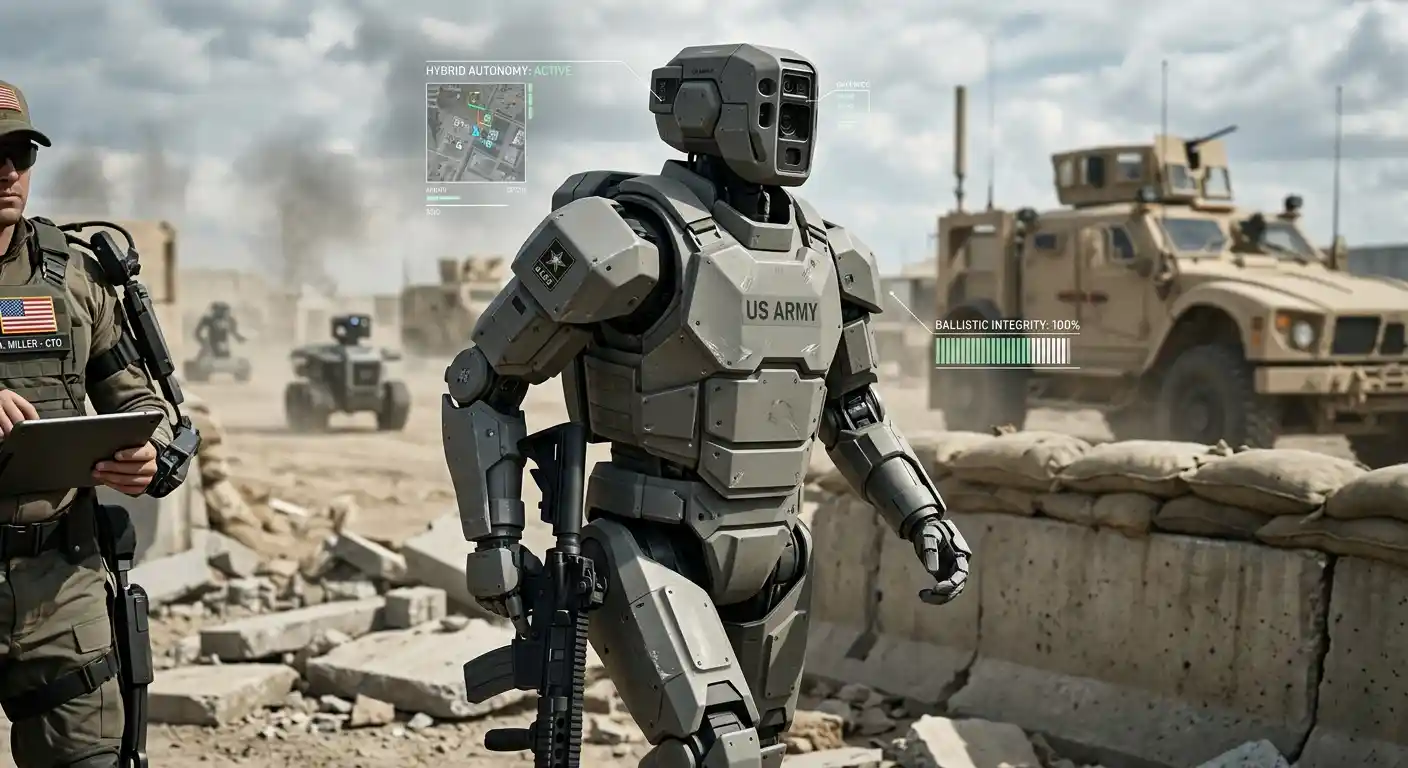
Developed by the Florida Institute for Human and Machine Cognition (IHMC), Alex represents a massive leap forward in ground robotics. While many existing military platforms rely on tracks or wheels, Alex utilizes a humanoid form factor to effortlessly navigate complex, unstructured terrain designed for human movement—such as stairs, narrow corridors, and urban debris.
Engineered with 29 dynamic joints, Alex achieves fluid, human-like motion that allows for precise operational flexibility. Powering these movements are highly backdriveable, custom quasi-direct drive actuators. These advanced components deliver exceptional energy efficiency while maintaining raw physical power. What truly distinguishes Alex from civilian prototypes, however, is its specialized ballistic armor. By combining reinforced protective plating with advanced hybrid autonomy—which seamlessly blends AI-driven tasks with real-time remote human oversight—Alex can undertake high-risk reconnaissance, breach hazardous environments, and protect human soldiers in extreme combat scenarios.
Global Defense Trends: The Rise of Autonomous Systems
The US military’s investment in humanoid platforms is not an isolated trend. Modern military doctrine across major global powers increasingly emphasizes autonomous and semi-autonomous systems. Unmanned aerial vehicles (UAVs), automated defense turrets, and uncrewed naval vessels already perform crucial intelligence and combat duties across global hotspots.
Global competitors are heavily prioritizing the militarization of robotics as well. Defense studies and official procurement records reveal that nations like China are aggressively accelerating research into humanoid platforms for future wartime deployment. As artificial intelligence advances, the race to deploy reliable robotic units in tactical environments has turned into a central pillar of international defense strategy. Humanoid robots offer the unique advantage of operating human-made equipment, vehicles, and weapons without requiring expensive infrastructure overhauls.
Strategic Advantages of Hybrid Autonomy
Fully autonomous robots often struggle when encountering unpredictable, chaotic battlefield situations. Conversely, purely teleoperated machines suffer from signal latency and heavy operator fatigue. The military’s push toward hybrid autonomy solves both limitations simultaneously.
Under a hybrid autonomy framework, embedded artificial intelligence algorithms manage basic physical motor skills, obstacle avoidance, balance recovery, and real-time path planning. Human operators maintain strategic oversight, making critical tactical decisions and approving complex actions. This balance maximizes operational efficiency, reduces cognitive load on military personnel, and ensures ethical, human-controlled oversight during sensitive engagements.
Future Outlook for Robotic Military Formations
As actuator performance, battery density, and machine learning models continue to mature, the presence of humanoid platforms within military forces will transition from experimental pilots to standard doctrine. These systems will initially handle chemical, biological, radiological, and nuclear (CBRN) reconnaissance, heavy logistics transport in dangerous corridors, and urban combat breaching.
By fielding physical platforms capable of absorbing initial operational contact, defense forces aim to dramatically reduce casualties while maintaining tactical superiority. The integration of ballistic protection with advanced tactile feedback ensures these machines interact safely with human soldiers, lift delicate equipment, and survive harsh operational conditions.