
Transparent concrete, often called light-transmitting concrete, is a cutting-edge composite material that blends the structural strength of cement-based concrete with the light-guiding capabilities of fiber optics. By embedding thousands of optical fibers into a fine-grained concrete matrix, designers achieve panels that remain load-bearing while channeling natural or artificial light across their cross-section. The result is an architectural material that looks solid yet glows from within—creating striking visual effects, improving daylight penetration, and enabling new possibilities for sustainable building design.
What Is Transparent Concrete?
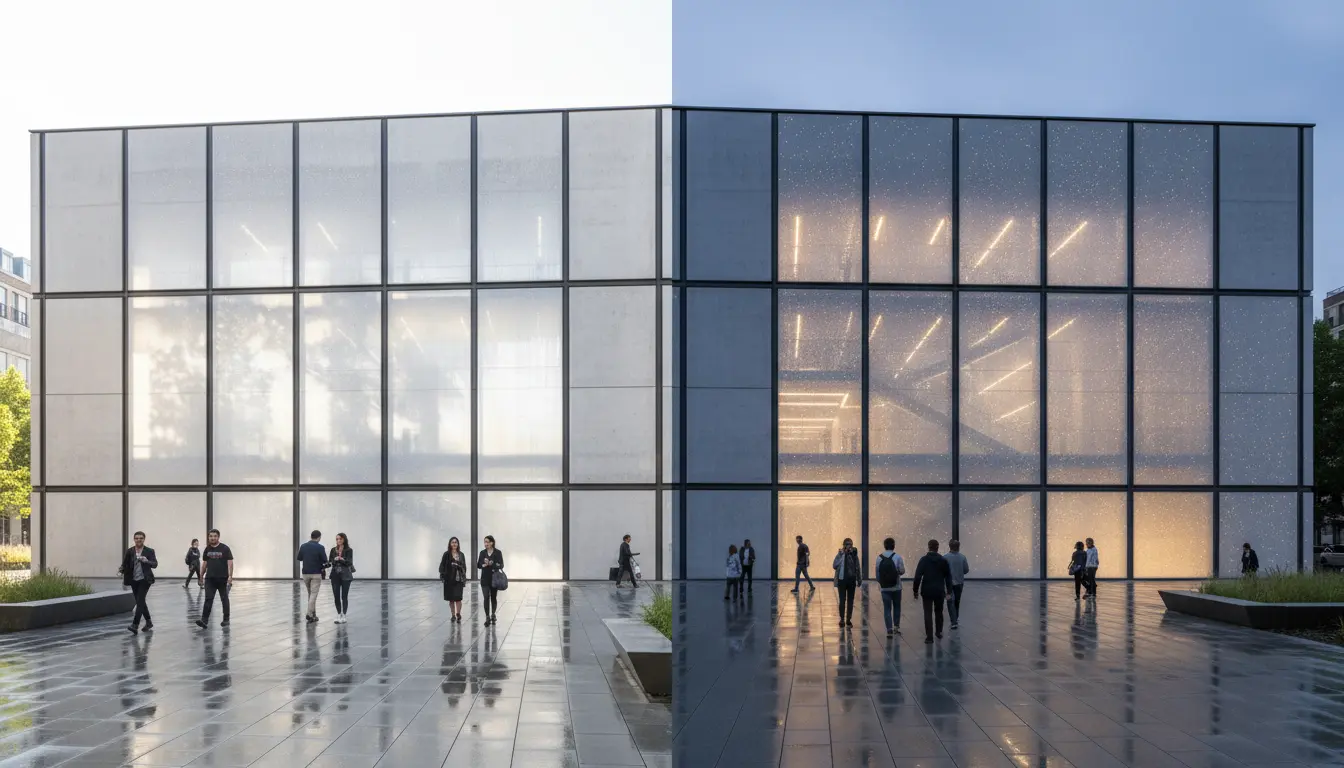
Transparent concrete is not “see-through” like glass; rather, it conducts light along the path of optical fibers cast within it. Each fiber acts as a tiny light pipe. When bundled in dense arrays—typically 3% to 5% by volume—these fibers allow patterns, silhouettes, and gradients of light to appear on the opposite face of the panel. Under direct sunlight, the effect can be dramatic, producing living shadows of trees, people, or urban scenes. Under artificial lighting, the panels can function as luminous walls, signage, or facade elements.
How Fiber Optics Enable Light Transmission
Fiber optics work through total internal reflection: light entering one end of the fiber bounces within the core due to a refractive index difference between the core and cladding. With low attenuation, the light emerges from the other end with minimal loss over short distances typical of wall panels (usually 25–500 mm). In transparent concrete, fibers are aligned roughly perpendicular to the panel faces to maximize throughput. The uniformity of fiber distribution, fiber diameter (commonly 0.25–2 mm), and panel thickness determine brightness, resolution, and the crispness of transmitted silhouettes.
Key variables:
- Fiber volume fraction: Higher fractions increase luminous flux but reduce compressive strength and complicate casting.
- Fiber diameter: Larger fibers boost brightness but lower resolution and may introduce visible dot patterns.
- Panel thickness: Thicker panels attenuate light; thinner panels transmit more but may limit structural performance.
- Matrix composition: Ultra-fine aggregates and careful water–cement ratios improve fiber bonding and reduce voids.
Manufacturing Process
- Mix design: A fine-grained, high-performance concrete (HPC) or UHPC is formulated for strength, durability, and fiber bond.
- Fiber placement: Optical fibers are pre-aligned in layers or mats. Precision spacers and jigs ensure consistent fiber density.
- Casting and compaction: Concrete is poured around the fibers and vibrated to remove air pockets, avoiding fiber displacement.
- Curing: Controlled curing preserves dimensional stability, bond quality, and surface finish.
- Finishing and cutting: Panels are cut, ground, or polished to expose clean fiber ends flush with the surface for optimal light output.
Advanced producers may use prefabricated fiber looms or 3D-printed alignment frames to maintain repeatability and reduce labor. Quality control focuses on fiber straightness, end-face polish, and uniform dispersion.
Structural Performance and Safety
Transparent concrete retains meaningful compressive strength, especially in UHPC-based mixes. While the fiber volume slightly reduces concrete cross-section, the reduction can be mitigated via:
- High-strength binders and micro-silica to enhance the matrix.
- Optimized reinforcement detailing around openings and anchors.
- Hybrid panels where light-transmitting zones are paired with conventional concrete ribs.
From a fire and safety perspective, optical fibers (typically PMMA or glass) must be selected for heat resistance and smoke behavior. In many applications, transparent concrete serves as cladding or partition walls rather than primary load-bearing elements, simplifying compliance. Proper testing for impact resistance, thermal cycling, and UV exposure ensures long-term performance.
Daylighting, Energy, and Sustainability
The ability to channel daylight deep into a space can reduce reliance on electric lighting during peak hours. When used judiciously:
- Daylighting autonomy can increase, improving occupant comfort.
- Glare can be managed by fiber density, panel orientation, and interior finishes.
- Nighttime scenes can be reversed: internal lighting turns the facade into a glowing canvas, reducing the need for external luminaires.
Sustainability considerations:
- Lower operational energy due to improved daylight use.
- Potential integration with low-carbon binders, recycled aggregates, or supplementary cementitious materials.
- Design for disassembly: modular panels that can be refurbished or reused.
Life cycle assessments depend on fiber content and manufacturing energy. The embodied energy of fibers is offset in long-lived installations where lighting energy savings are significant.
Design Applications
- Facades and curtain walls: Create dynamic patterns that respond to the sun’s angle and the movement of people behind them.
- Interior partitions: Define zones while preserving privacy; only light and silhouette pass through, not detail.
- Stairwells and corridors: Increase perceived safety and orientation with daylight ribbons.
- Public art and installations: Transform civic spaces with luminous monoliths and patterned light sculptures.
- Branding and signage: Cut-through light channels or CNC-routed cavities can form logos and wayfinding cues.
Aesthetic strategies include gradient fiber densities, parametric dot fields, and mixed materials (wood, metal, or stone) to create layered compositions. Pairing with LEDs enables programmable effects and media facades.
Integration and Detailing Best Practices
- Anchoring and framing: Use standard facade anchors, ensuring compressive bearing and avoiding point loads on fiber ends.
- Weatherproofing: Treat panel joints with gaskets or sealants; fibers themselves are continuous and typically not water paths.
- Thermal movement: Allow for expansion and contraction with engineered joints.
- Electrical and lighting: For luminous effects at night, integrate linear LEDs along panel edges or back faces; verify heat dissipation.
- Maintenance: Clean with non-abrasive methods to preserve fiber end polish; avoid aggressive chemicals that can craze PMMA fibers.
Cost, Scalability, and ROI
Transparent concrete is more expensive per square meter than conventional cladding due to specialized fabrication and fiber costs. However, total cost of ownership can be justified by:
- Reduced lighting energy in select zones.
- Iconic architectural value that elevates brand and foot traffic.
- Durability compared to more fragile glazing in certain settings.
For scalability, modular standard-size panels, automation in fiber laying, and supply-chain partnerships drive down costs. Early collaboration among architects, structural engineers, and fabricators is crucial to balance light performance with structural and budget targets.
Future Directions
- Smart fibers with embedded sensors for structural health monitoring or occupancy detection.
- Tunable optics: micro-lenses or diffusers at fiber ends to shape light distribution.
- Hybrid translucent concretes combining aerogels for thermal performance with optical fibers for light.
- Additive manufacturing of fiber channels for custom imagery and text without hand-aligned bundles.
Conclusion
Transparent concrete with fiber optic light transmission bridges a long-standing gap between mass and luminosity. It retains the timeless solidity of concrete while delivering the experiential and sustainable benefits of daylight. With careful design of fiber density, panel thickness, and matrix performance, project teams can achieve striking aesthetics, measurable energy gains, and durable installations that redefine what concrete can be.