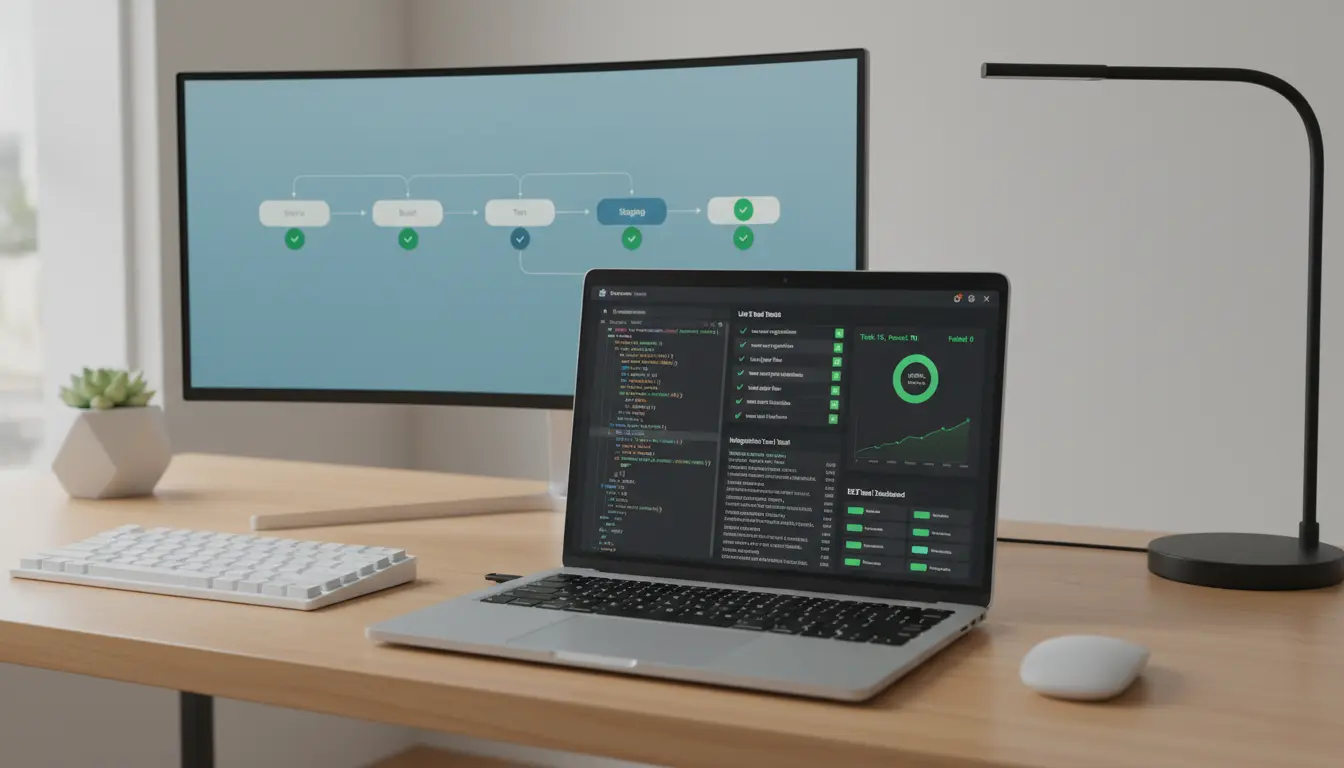

What Is Software Testing? A Practical Guide to Unit, Integration, and E2E Tests
Software testing is the process of verifying that an application works as intended, is reliable, secure, and delivers value to users. Instead of waiting for users to find bugs in production, development teams design and run tests during and after implementation. These tests reveal defects, performance issues, and edge cases before they become costly problems.
Modern development practices such as Agile, DevOps, and CI/CD make software testing an ongoing activity, not just a final step before release. To build robust applications, teams commonly use three foundational test levels:
- Unit tests
- Integration tests
- End-to-end (E2E) tests
Each level focuses on different parts of the system and catches different kinds of defects. When you combine them thoughtfully, you create a strong safety net that supports fast and confident releases.
Why Software Testing Matters
Without a systematic testing strategy, even well-written code can fail under real-world conditions. Software testing matters because it:
- Reduces bugs in production: Early detection is cheaper and faster to fix.
- Improves code quality: Tests enforce better design, cleaner interfaces, and maintainable modules.
- Builds trust: Reliable software increases user satisfaction and loyalty.
- Supports fast iteration: Automated test suites allow teams to ship features frequently with less risk.
- Protects business value: Fewer outages, security issues, and regressions mean lower operational costs.
A solid understanding of unit, integration, and E2E tests helps you design a testing strategy that balances speed, coverage, and reliability.
What Is Unit Testing?
Unit testing focuses on the smallest testable parts of your code—usually individual functions, methods, or classes. The goal is to prove that each unit behaves correctly in isolation.
In a unit test, you usually:
- Call a single function or method with a known set of inputs
- Assert that the output or side effects match expectations
- Run tests quickly and frequently, ideally on every commit or push
Unit tests are fast, deterministic, and cheap to run. They give developers immediate feedback and help prevent regressions when refactoring or adding new features.
Benefits of Unit Testing
- Fast feedback loop: You know within seconds if a change broke existing behavior.
- Simpler debugging: If a unit test fails, you know exactly where the failure originates.
- Improved design: Units that are easy to test are often loosely coupled and more modular.
- Reliable refactoring: When you change internal implementations, unit tests ensure the public behavior remains consistent.
Best Practices for Unit Tests
To get the maximum value from unit testing:
- Test one thing per test: Keep tests focused and readable.
- Avoid external dependencies: Use mocks or stubs for databases, APIs, or file systems.
- Run unit tests on every build: Integrate them into your CI pipeline.
- Aim for meaningful coverage: Coverage metrics matter, but only when tests are high quality and assert real behavior.
What Is Integration Testing?
Integration testing verifies how multiple units or components work together. While unit tests focus on individual building blocks, integration tests ensure that these blocks interact correctly.
Typical integration tests might check:
- Communication between a service and its database
- Interactions between microservices over HTTP or messaging queues
- Data flow between modules in a layered architecture (e.g., controller → service → repository)
Instead of mocking every dependency, integration tests rely more on real configurations or realistic test doubles. They often run against test databases or staging environments.
Benefits of Integration Testing
- Validates real-world interactions: Catch issues like incorrect configurations, schema mismatches, or serialization problems.
- Reduces environment-specific bugs: Helps detect issues that appear only when components run together.
- Increases confidence in architecture: Confirms that your system’s contracts and boundaries are well-defined and stable.
Best Practices for Integration Tests
- Test critical paths: Focus on the workflows that deliver the most business value.
- Use stable test data: Seed predictable data sets and clean up after test runs.
- Automate execution: Run integration tests regularly—often as a separate stage in CI.
- Balance depth and cost: Integration tests are slower and more complex; use them where they add clear value.
What Is End-to-End (E2E) Testing?
End-to-end testing validates the entire application flow from the user’s perspective. An E2E test simulates real user behavior by interacting with the UI or API as a client would, traversing through the frontend, backend, database, and external services.
For example, an E2E test for an e-commerce site might:
- Open the homepage
- Search for a product
- Add it to the cart
- Proceed to checkout
- Complete the payment flow
- Verify that an order appears in the user’s order history
E2E tests ensure that all integrated parts of the system work together under realistic conditions.
Benefits of E2E Testing
- User-centric validation: Confirms that the most important user journeys work as intended.
- Catches cross-layer issues: Uncovers problems that only appear when all layers interact.
- Supports regression protection: Prevents changes in one area from silently breaking another.
Challenges and Best Practices for E2E Tests
E2E tests are powerful but also:
- Slower and more brittle: UI changes or timing issues can cause test flakiness.
- Harder to maintain: Large test suites require careful design and regular updates.
To manage these challenges:
- Prioritize key scenarios: Cover the most valuable and high-risk user flows first.
- Isolate flaky dependencies: Use test environments, feature flags, and realistic mocks for third-party providers.
- Keep tests deterministic: Avoid relying on real-time delays or unpredictable external services.
- Integrate into CI: Run a targeted E2E suite on every merge and a broader suite on a schedule.
Designing a Balanced Testing Strategy
A robust testing strategy does not rely solely on any single type of test. Instead, it layers multiple levels of tests to achieve reliable coverage with reasonable cost. A common way to visualize this is the testing pyramid:
- Base: Unit Tests (many, very fast)
- Middle: Integration Tests (fewer, slower)
- Top: E2E Tests (few, slowest)
You can apply these principles:
- Use many unit tests to validate core business logic.
- Use a moderate number of integration tests to confirm that critical modules interact correctly.
- Use a small, focused set of E2E tests to verify essential user journeys.
This combination keeps your feedback loop fast, your quality high, and your maintenance burden manageable.
Automation, CI/CD, and Test Maintenance
Automated testing becomes significantly more valuable when integrated into your CI/CD pipeline. Every change should trigger:
- A full run of the unit test suite
- Targeted integration tests for impacted services
- Selected E2E tests for critical flows
Over time, you need to maintain and refactor your tests just like production code. Remove obsolete tests, update assertions when requirements change, and continuously improve test reliability. High-quality automated tests become long-term assets that protect your codebase and speed up development.