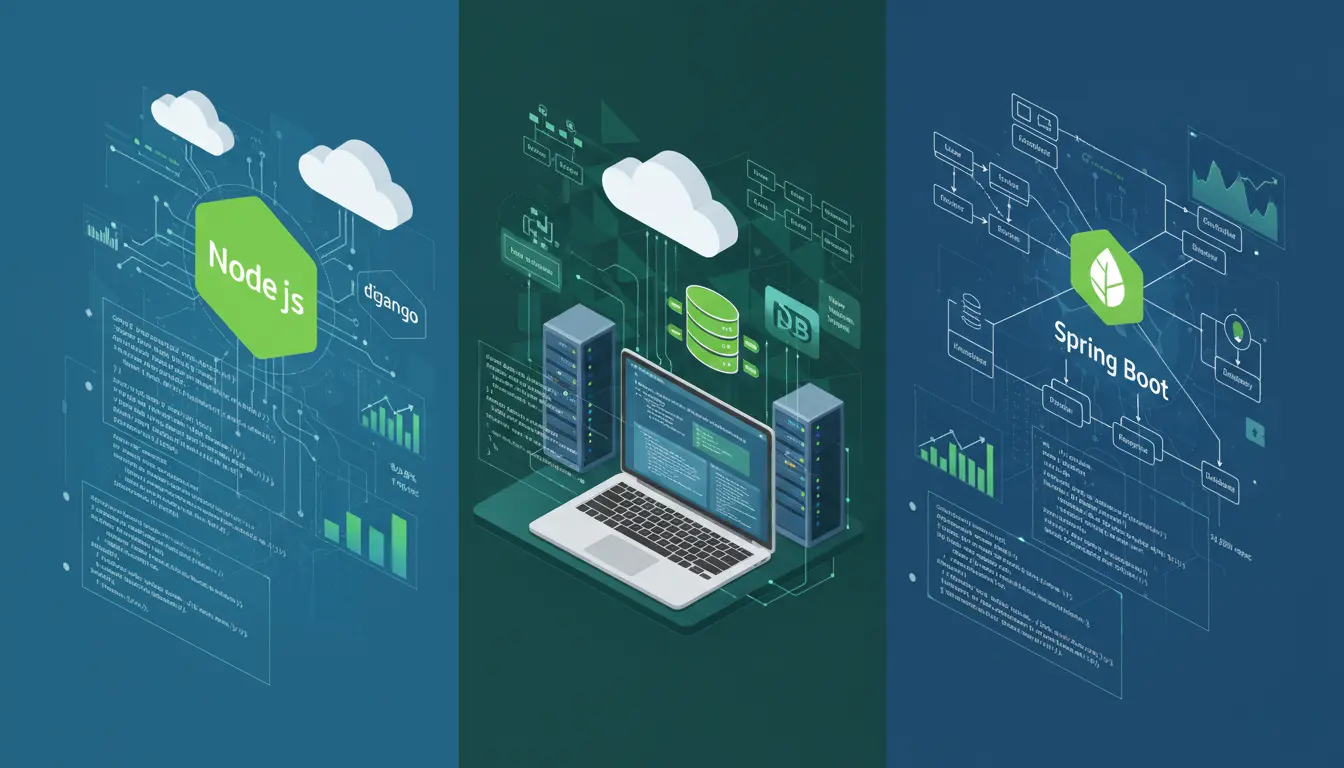

Backend Framework Showdown: Node.js vs Django vs Spring Boot
Choosing the right backend framework is one of the most important decisions in modern web application development. Your choice directly affects performance, scalability, security, and developer productivity. Among all options, Node.js, Django, and Spring Boot consistently stand out as three of the most popular backend frameworks for building robust and scalable applications.
Each framework offers a different philosophy: Node.js focuses on non-blocking JavaScript performance, Django emphasizes rapid development with Python, and Spring Boot brings battle‑tested enterprise power from the Java ecosystem. Understanding their strengths, weaknesses, and ideal use cases helps you make an informed decision for your next project.
What Is Node.js?
Node.js is a JavaScript runtime built on Chrome’s V8 engine that enables server-side development with JavaScript. Instead of using a traditional multi-threaded model, Node.js relies on an event-driven, non-blocking I/O architecture. This design makes it highly efficient for handling a large number of simultaneous connections.


Developers often use Node.js for real-time applications, such as chat apps, gaming backends, streaming services, and APIs that serve high traffic. The vast NPM ecosystem provides libraries for almost every use case, from authentication and logging to advanced caching and monitoring.
Key advantages of Node.js include:
- High concurrency with a lightweight event loop
- Excellent fit for microservices architecture and API‑first design
- Code reuse between frontend and backend using JavaScript
- Fast prototyping for startups and agile teams
However, Node.js may require careful backend performance optimization when dealing with CPU‑heavy tasks, because its single-threaded nature is not ideal for intense computation without additional strategies like worker threads or offloading.
What Is Django?
Django is a high-level Python web framework that follows the “batteries included” philosophy. It ships with a powerful ORM, authentication system, admin interface, form handling, and many security features out of the box. Django’s architecture follows the Model–Template–View (MTV/MVT) pattern, which encourages clean separation of concerns.
Django is particularly strong when you need secure, content-driven websites and data-rich applications. Because Python is one of the most popular languages for data science and machine learning, Django also integrates well into ecosystems where AI and analytics are important.
Highlights of Django:
- Very fast development with built‑in features and conventions
- Strong protection against common security risks, such as SQL injection, XSS, and CSRF
- Stable choice for enterprise-level applications and high traffic sites
- Excellent admin panel for managing data without writing extra code
While Django can support microservices, its traditional strength lies in more monolithic architectures that still scale effectively with good infrastructure and caching strategies. It remains a top choice for teams that value clean code, security best practices, and rapid development.
What Is Spring Boot?
Spring Boot is an opinionated framework built on top of the powerful Spring ecosystem in Java. It simplifies the configuration-heavy nature of classic Spring by offering auto-configuration, embedded servers, and production-ready features. This makes it a popular option for building cloud-native development projects and enterprise microservices.
Spring Boot excels when you need strong type safety, mature tooling, and long-term maintainability. Many large organizations in finance, telecom, and e‑commerce rely on Java enterprise solutions powered by Spring Boot for mission‑critical systems.
Core strengths of Spring Boot:
- First-class support for microservices architecture and distributed systems
- Deep integration with cloud platforms, observability tools, and CI/CD pipelines
- Excellent performance on the JVM for high traffic applications
- Rich ecosystem including Spring Security, Spring Data, and Spring Cloud
Because it runs on the JVM, Spring Boot can deliver impressive web application performance, but the learning curve is steeper than Node.js or Django, especially for developers new to Java or enterprise architectures.
Performance and Scalability Comparison
When you compare Node.js vs Django vs Spring Boot from a performance perspective, the story depends heavily on the type of workload.
- Node.js shines in I/O‑bound scenarios. Its non-blocking model allows it to handle many concurrent connections with minimal resource usage. This makes it great for APIs, real-time features, and lightweight services where response time matters more than heavy computations.
- Django provides solid performance for most typical web applications, especially when combined with database indexing, caching layers, and connection pooling. Although Python is not the fastest language, Django’s mature stack and ecosystem make optimization relatively straightforward for experienced developers.
- Spring Boot often leads for CPU‑intensive and large‑scale enterprise-level architecture. Java’s JIT compilation and JVM tuning options enable impressive throughput, especially under sustained high load. For complex domains and large teams, Spring Boot can offer both speed and reliability.
In terms of scalability:
- Node.js and Spring Boot are natural fits for microservices and distributed systems.
- Django can scale horizontally using techniques like load balancing, read replicas, and caching, but its sweet spot is large, well-structured monoliths or service-oriented architectures rather than ultra‑granular microservices from day one.
Developer Experience and Learning Curve
Developer experience is just as important as raw performance, especially for long projects and large teams.
- Node.js is ideal if your team already works heavily with JavaScript on the frontend. Using a single language across the stack simplifies hiring and collaboration. With frameworks like Express.js or NestJS on top of Node.js, you can structure projects cleanly while retaining flexibility.
- Django offers an extremely productive workflow, particularly for API development and content-heavy sites. Its convention-over-configuration approach, built-in admin, and rich documentation allow developers to ship features quickly. If your team is comfortable with Python, Django becomes one of the most efficient choices.
- Spring Boot has the steepest learning curve but offers the most comprehensive set of enterprise features. Strong typing, powerful IDE support, and explicit design patterns make it well-suited for teams that value robustness, consistency, and long-term maintainability in complex backend systems.
Best Use Cases for Each Framework
You can think of the three frameworks as optimized for different dimensions of backend development:
- Choose Node.js when:
- You build real-time features like chats, live dashboards, or collaborative tools
- You want a lightweight, fast API layer for SPAs or mobile apps
- You adopt microservices architecture with many small, independently deployable services
- Choose Django when:
- You need strong security and reliable security best practices by default
- You build CMSs, marketplaces, social platforms, or data‑driven dashboards
- You want to integrate easily with Python-based data science or ML components
- Choose Spring Boot when:
- You develop large-scale enterprise-level applications with complex business rules
- You require strict reliability, transaction management, and advanced integration patterns
- You are targeting cloud-native, containerized deployments with strong observability requirements
There is no single “best” backend framework. Instead, the right choice depends on your team’s skills, project timeline, performance expectations, and long-term product roadmap.
Conclusion: How to Choose Between Node.js, Django, and Spring Boot
To select the right backend technology, start from your business requirements and your team’s expertise. If you prioritize speed of prototyping and shared language between frontend and backend, Node.js is a strong candidate. If you want a secure, batteries‑included framework with a clean architecture and Python’s elegance, Django is hard to beat. If you are building complex, high‑reliability systems that demand strong scalable architecture in an enterprise setting, Spring Boot is often the safest long‑term investment.
By carefully analyzing performance needs, scalability goals, and your development culture, you can confidently choose between Node.js, Django, and Spring Boot and lay a solid foundation for modern, maintainable backend infrastructure.
Recommended Product from Amazon
For a deeper understanding of building modern, scalable backend systems, this book is extremely valuable:
“Designing Data-Intensive Applications” by Martin Kleppmann