
New 300-Nanometer Electrode Design Could Make EV Batteries Lighter and Last Longer
A New Direction for Electric Vehicle Battery Technology
Electric vehicles need batteries that store more energy without becoming heavier, larger, or less reliable. Researchers are now exploring a new electrode design that could address several of these challenges at the same time.
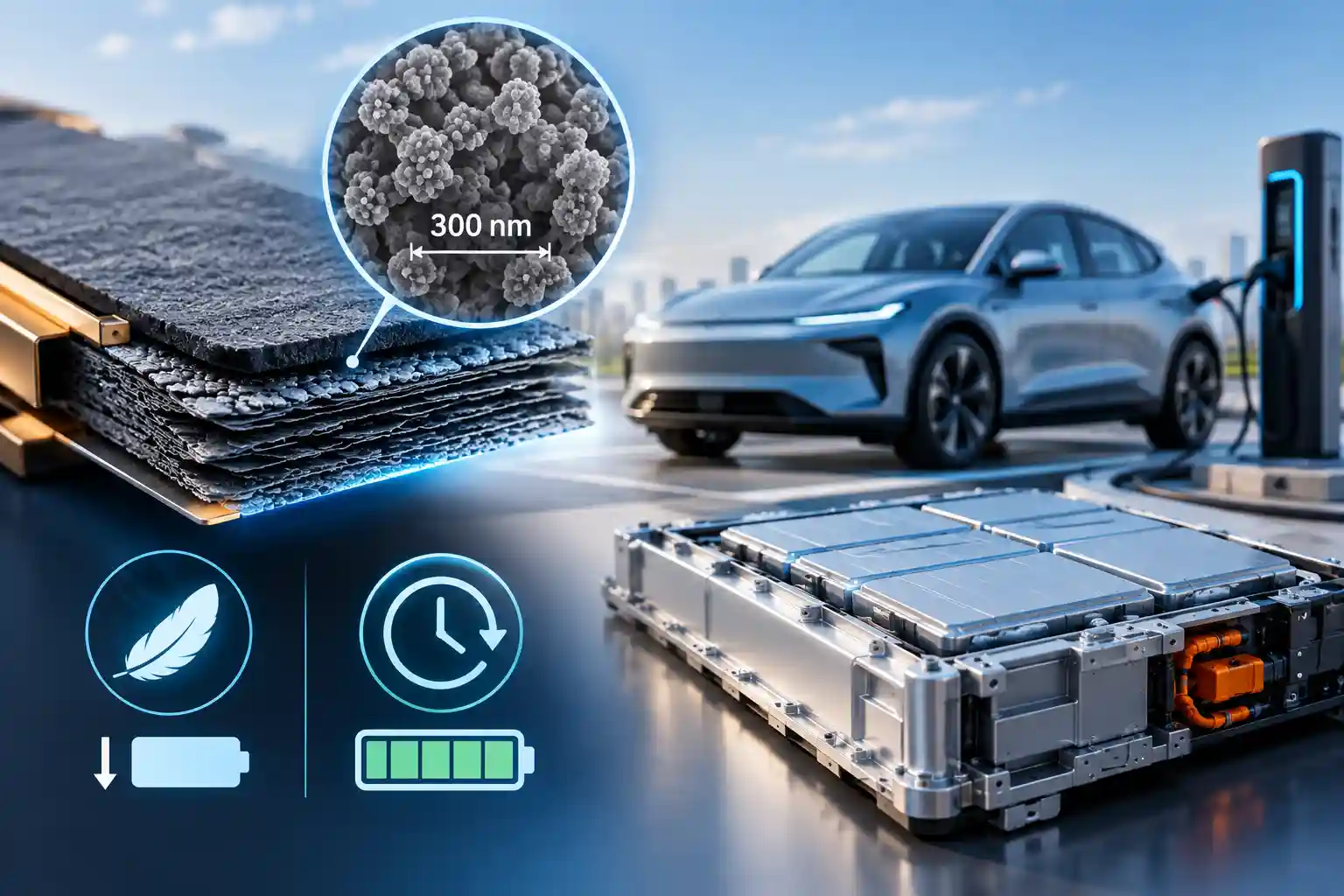
A South Korean research team has developed a nanoscale copper electrode structure designed for anode-free batteries. The design uses tiny tube-shaped structures that measure approximately 300 nanometers across and 150 nanometers high. These microscopic features help guide lithium deposition and may improve the durability of next-generation electric vehicle batteries.
The research could support the development of lighter EV battery packs, longer driving ranges, and improved battery cycle life. However, the technology still requires further testing before manufacturers can use it in commercial vehicles.
Why Anode-Free Batteries Matter
Most conventional lithium-ion batteries use graphite as the anode. During charging, lithium ions move through the electrolyte and settle inside the graphite structure. Although this design has become widely established, graphite adds weight and occupies valuable space inside the battery cell.
Anode-free batteries take a different approach. Instead of using a separate anode material, they deposit lithium directly onto a thin copper current collector during charging. This configuration can reduce inactive battery materials and create more room for energy-storing components.
In theory, anode-free batteries can deliver a higher energy density than traditional lithium-ion cells. Higher energy density could help automakers produce smaller battery packs with similar capacity or provide more driving range without increasing the vehicle’s overall size.
Despite this potential, anode-free battery technology faces a major problem: lithium does not always deposit evenly across a flat copper surface.
The Problem of Lithium Dendrites
Uneven lithium deposition can create sharp, branch-like formations called dendrites. These structures may damage the protective layer around the lithium and trigger unwanted chemical reactions with the electrolyte.
As dendrites continue to grow, they can reduce battery performance during repeated charging and discharging cycles. In severe cases, they may also create safety concerns by damaging internal battery components.
Researchers have tested several solutions, including adding extra lithium and applying thick protective coatings. These approaches can reduce lithium loss, but they may also increase the battery’s weight, volume, or manufacturing complexity.
The new electrode design attempts to solve the problem by controlling where lithium deposits instead of simply adding more protective material.
How the 300-Nanometer Structure Guides Lithium
The research team used a semiconductor-inspired fabrication method called secondary sputtering lithography. This technique allowed the researchers to create regularly spaced, tube-shaped structures across the copper foil.
These structures provide defined areas where lithium can settle. Rather than allowing lithium to collect in isolated locations, the patterned surface encourages a more even distribution across the electrode.
The structured copper foil offers approximately four times more surface area for lithium deposition than untreated flat copper foil. A larger surface area can reduce the local concentration of lithium and limit the formation of dendritic growth.
The concept resembles an organized parking lot. Clearly marked spaces guide vehicles into separate positions instead of allowing them to gather randomly in one crowded area. In the same way, the nanoscale tubes guide lithium toward more controlled deposition sites.
An Ultrathin MXene Layer Adds Protection
The researchers also added an MXene coating approximately 10 nanometers thick. MXenes are two-dimensional materials that researchers study for their electrical and electrochemical properties.
In this battery design, the MXene layer does not act as a thick physical shield. Instead, it works more like a primer. When used with a lithium hexafluorophosphate-based electrolyte, the coating encourages the formation of a more uniform protective layer that contains lithium fluoride.
This protective layer helps reduce unwanted reactions between lithium and the electrolyte. It also supports the suppression of dendrite growth during battery operation.
The research team analyzed the electrode using advanced methods, including X-ray photoelectron spectroscopy, time-of-flight secondary ion mass spectrometry, and transmission electron microscopy.
What This Could Mean for EV Drivers
If future manufacturers successfully scale this technology, electric vehicles could benefit from lighter and more compact battery packs. A lighter battery may improve vehicle efficiency, while a higher energy density could extend driving range.
The design may also help improve long-term battery performance by reducing the damage caused by uneven lithium deposition. Better cycle stability could support electric vehicles that retain useful capacity after more charging cycles.
Still, laboratory progress does not automatically guarantee mass production. Researchers must evaluate manufacturing costs, high-volume production methods, fast-charging performance, temperature behavior, and long-term safety before the technology can reach the automotive market.
The Future of Anode-Free Battery Development
The 300-nanometer electrode structure demonstrates how nanoscale engineering can influence large-scale transportation technology. By combining controlled surface architecture with an ultrathin MXene coating, researchers created a strategy that addresses both lithium distribution and electrolyte stability.
The approach could become an important step toward more efficient solid-state and advanced lithium-metal battery systems. As electric vehicle adoption grows, innovations that reduce battery weight while increasing energy storage will remain highly valuable.
Amazon Product Recommendation
For EV owners who want a practical charging accessory while battery research continues to advance, the EVDANCE Level 1&2 EV Charger is one option listed on Amazon.com’s EV charger marketplace. The listing describes a portable charger with J1772 compatibility and adjustable charging options. Buyers should confirm connector type, voltage requirements, vehicle compatibility, and local electrical regulations before purchasing.